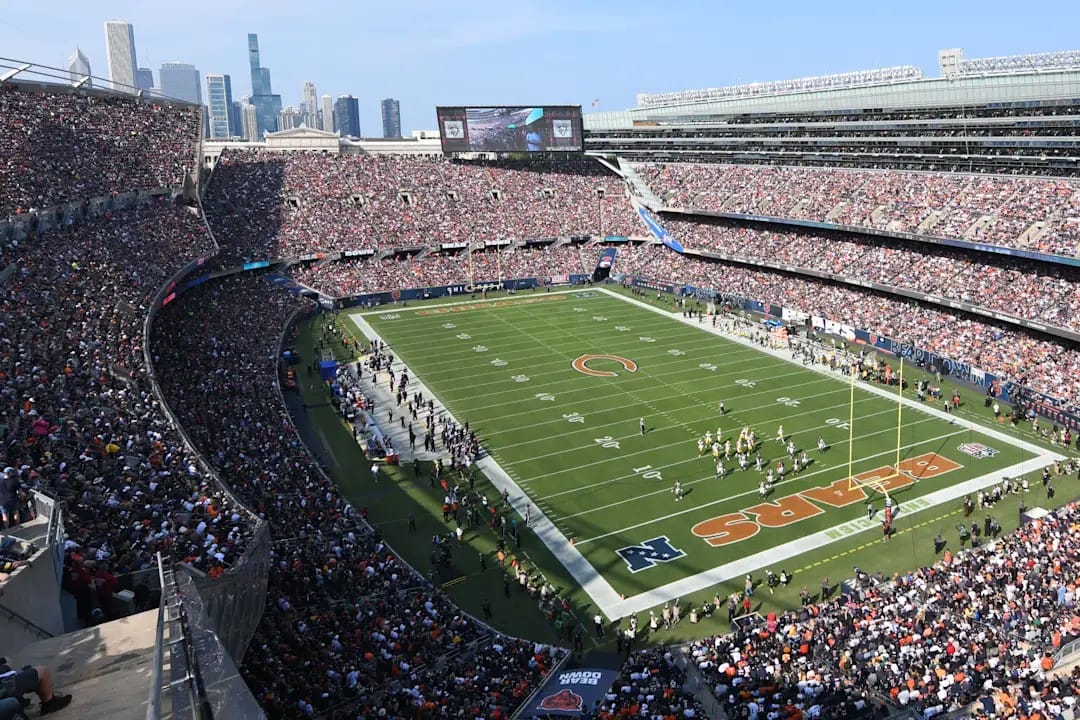
Adam Hoge went on The Score this week and delivered the line Halas Hall wanted delivered, in the tone Halas Hall wanted it delivered in: “This Kyler Gordon situation has veered into Nate Davis territory.“
Stickin’ up white boys in ball courts My life got no better, same damn ‘Lo sweater Times is rough and tough like leather Figured out I went the wrong route So I got with a sick-ass clique and went all out Catchin’ keys from ‘cross seas Rollin’ in MPV’s, every week we made forty G’s
-Cash Rules, WTC
Nate Davis fucking territory. What the fuck is Nate Davis territory, exactly? A man who signed a contract, collected the guaranteed portion of that contract, and walked out of professional football at 28 with his brain in its original packaging. That’s the Nate fucking Davis territory. That’s the cautionary tale for hedge fund fucks. In the National Football League, the scandal isn’t the man who leaves in a wheelchair. The scandal is the man who leaves. Note the period, player. And Hoge — who (let’s be honest) functions as the friendly neighborhood Spider-conduit through which Halas Hall’s frustrations get laundered into “reporting” — knows exactly what he’s doing when he invokes that name.
It’s not analysis. It’s his branding iron. The building is fed up (i.e. Ben is unhappy), the building can’t get a read on Gordon’s work, the building doesn’t think it knows him. So the building picks up the phone, and by Wednesday the vibes have been transcribed, and a 26-year-old on a stationary bike is being measured for the Nate Davis label.
Let me be clear about what I know, which is nothing, which is the point. I don’t know if Kyler Gordon’s calf is shredded or fine. Neither do you. Neither, by their own aggravated admission, does the front office paying him. Ryan Poles stood at a podium and said “he’s frustrated, we’re frustrated,” which is what a GM says when the MRI and the roster bonus are having an argument the fans aren’t allowed to hear. Gordon missed 14 games last year. He’s on the PUP list now. He posted a workout video to Instagram the same day the knives came out, because if nothing else the man has a sommelier’s timing for social media. Smart play. Maybe he’s hurt. Maybe he’s hurting exactly as much as is medically documentable. The distinction matters enormously to lawyers and not at all to fans.
Because here’s the thought experiment the league cannot survive, the one that turns the whole apparatus inside out:
Suppose a player decided to be mega rational.
Suppose a young man looked at the actuarial tables of his own profession — the average career under four years, the guaranteed money a fraction of the sticker price, the pension a punchline, the disability Medicaid like process a war of attrition designed to outlast the applicant — and drew the obvious goddamn conclusion. Play brilliantly on the rookie deal. Play brilliantly enough to trigger the second contract, the one with real guarantees. Sign it. And then let the body say what the body has been saying all along: no more. Soft tissue. Calf. Back tightness on a Sunday morning. Injuries that are real in the way all football injuries are real — which is to say, every man on that field is injured, always, and “healthy” is just the injury level at which the team’s doctors will clear you to absorb more. Grab some Vicodin from the glass bowl on your way out.
The guaranteed money is guaranteed. That was the deal. The team signed it with a battalion of lawyers and cap analysts and the full negotiating leverage of a cartel exempted from antitrust law. Nobody held a gun to Ryan Poles’ head in March 2023 when he wired Nate Davis $19.25 million guaranteed. The Bears got 13 starts for it, and the commentariat (and grumpy fans) call that a heist — but notice who’s holding the bag and who they blame. They don’t blame the front office that scouted a man they’d apparently never met. They don’t blame the structure that makes teams pretend every contract is real when only the guarantee is. They blame the player. For cashing the check. That he was contractually owed. From a franchise worth six billion dollars that plays in a publicly subsidized stadium and is currently shaking down two municipalities simultaneously for a new one.
The NFL fears the mega rational player more than it fears any linebacker. Owners who lecture the country about work ethic, who fund politicians campaigning to push retirement to 70 and beyond, who inherited their franchises the way the McCaskeys inherited theirs — by being born adjacent to the money — are terrified of a labor force that reads its own contracts. Every mechanism of the sport exists to prevent that reading. The injury report as public shaming. The “questionable” tag as loyalty test. The insider-media complex as enforcement wing, delivering the; ‘he doesn’t like to practice‘ whisper campaign, free of charge, whenever a body stops producing. It’s a company town, and the company newsletter has a podcast.
And what does the company owe in return? Ask Dave Duerson. Super Bowl XX Bear. Pro Bowler. A man this franchise wrapped in Monsters of the Midway mythology right up until February 2011, when he shot himself in the chest — the chest, deliberately, specifically — so that his brain would survive intact for the researchers. He texted his family first: get it to the brain bank. He turned his own suicide into evidence handling, because he knew the league would dispute anything less than a preserved specimen. They found the CTE. A year later Junior Seau did the same thing the same way. The league that now clutches pearls over a calf injury spent two decades funding junk science to deny what was happening inside its employees’ skulls — and then, when it finally settled, its lawyers deployed race-norming in the payout formulas: the assumption, baked into the cognitive testing, that Black players started from a lower baseline of brain function, so their demonstrated damage was worth less money. That’s not my inflammatory metaphor. That’s the settlement administration, litigated in open court, abandoned only in 2021 after two players sued and the story broke wide open. The league didn’t need anyone to caricature its view of its Black labor force. It wrote the caricature into the actuarial tables itself. House negro indeed.
So, when this apparatus tells me a defensive back on a bike is a character problem, my response is: hooray. Genuinely. If — if — some player somewhere has cracked the code, has figured out how to extract the guarantee and decline the dementia, then he is not the scandal. He is the control group. He’s the one player in the experiment who didn’t take the pill, and the league needs him ridiculed precisely because his existence reframes everyone else’s outcome as a choice the league made for them. It’s your circus but the clowns ain’t free, dawg.
Watch what comes next, because it’s already forming. Clawback language will start creeping into second contracts — de facto guarantee erosion dressed up as “availability incentives.” The owners will coordinate on it the way they coordinate on everything, which is to say illegally in spirit and immaculately in paperwork, the collusion always somehow unprovable, the way Lamar Jackson’s fully-guaranteed market evaporated overnight after Deshaun Watson’s deal. And the NFLPA — the only major sports union that has never once out-negotiated its counterparty, currently between leadership scandals, institutionally incapable of protecting a player from so much as a Thursday night game — will trade it all away for a bump in offseason workout stipends and call it a win. The players who ran the rational strategy will be the pretext. Their names will be said the way Hoge said “Nate Davis territory“: as a diagnosis. Sick the Dobermans on the lazy slaves.
Fine. Let them say it. Nate Davis will never do a soup commercial. He will never be invited to throw out a jersey number at the draft, never get the Halas Hall alumni-weekend golf invite, never be beloved. He will also never text his family instructions about his brain. Somewhere there’s a beach — Panama’s nice, I hear, the dollar goes far and nobody there has strong opinions about the interior of the Bears’ offensive line — where a man can sit with his guaranteed money and his intact hippocampus and watch the sunset in the correct order, remembering yesterday’s sunset too.
The league will tell you that’s a tragedy. The league buried Dave Duerson without a notice.
A purgatory with no one home by GP ★★★½ out of ★★★★
Dir. Kane Parsons. Written by Will Soodik. Starring Chiwetel Ejiofor, Renate Reinsve, and Mark Duplass. A24.
There is a particular kind of dread that doesn’t announce itself with a monster. It comes instead from a room that was built to be full and isn’t — an office with the lights on and no one at the desks, a showroom staged for customers who never arrive, a corridor that goes on slightly too long. Backrooms, the feature debut of twenty-year-old Kane Parsons, is two hours of that feeling, and the remarkable thing is not that a internet-born horror premise survived its trip to the big screen. The remarkable thing is that the kid who made it understood his own material well enough to bury a metaphysical argument underneath the yellow fluorescents — and then had the discipline not to explain it.
The setup is almost insultingly modest. Clark (Chiwetel Ejiofor) is a failed architect who now owns a dying furniture store called Cap’n Clark’s Ottoman Empire, a man marinating in alcohol and a recent divorce, sleeping among his unsold inventory because his wife has thrown him out of the house he won’t stop reminding everyone he pays for. He sees a therapist, Dr. Mary Kline (Renate Reinsve). The electrical bill is too high. The lights flicker. And one night, in the basement, Clark finds a slit in the wall, pushes his hand through it, and falls into the place the internet has spent half a decade mythologizing: an apparently infinite expanse of liminal rooms, sourceless light, and furniture rendered slightly, sickeningly wrong.
(What follows discusses the film in full, ending and all. The spoiler architecture is best entered cold; consider this your slit in the wall.)
What elevates Backrooms above its found-footage ancestry is that Parsons and screenwriter Will Soodik refuse to decide what the place is. It plays two registers at once and never blinks. The Backrooms may be a literal alternate dimension — there is, after all, a shadowy institute called Async that has been mapping it since the late 1980s, complete with infrastructure and prior casualties. Or the Backrooms may be the externalized interior of a collapsing man. The film’s horror depends precisely on both being true simultaneously, and on the audience never being granted the mercy of choosing.
Consider the furniture. The space doesn’t contain random clutter; it is copying Clark’s world — his store, specifically — and doing it badly. His inventory comes back to him fused into piles, stacked in arrangements that obey no human logic, malformed. Clark himself supplies the film’s best description of the phenomenon: it’s like a drawing of a dog made by someone who has never seen a dog and is working only from a verbal description. The Backrooms reproduce from secondhand memory, so everything emerges a little incorrect. And here is the quiet brilliance of the conceit, the thing that makes a 2026 horror film feel like a nerve struck rather than a trend chased: this is the exact uncanniness of machine-generated imagery. A reality reconstituted by a process that has no comprehension of what it’s reconstituting. Parsons has made a film whose central monster is bad reproduction itself, and he did it without once saying the letters “AI.” A furniture salesman’s mediocre merchandise, copied by something that doesn’t understand furniture, in an infinite badly-designed building — the perfect hell, it turns out, for a man whose entire life was the failed design and furnishing of spaces.
Ejiofor is extraordinary, and the role asks for a specific and difficult arc: he has to be sympathetic enough that we follow him down, and then curdle. Clark’s tragedy, as Mary keeps gently surfacing in their sessions, is that he is a man who has already decided who ruined his life — the ex-wife, the career, the store, the world — anyone but the man telling the story. The Backrooms offer him a seductive rewrite. He is not a failure; he is an explorer. Not stuck; chosen. Not lost; the discoverer of the secret architecture beneath reality. Ejiofor lets us watch a wounded man fall in love with the one story that finally casts him as the hero, and then lets that love rot into something monstrous.
By the time he has dragged his two employees into the maze and lost them to it, and lured Mary in after, the curdle is complete. The film’s most disturbing sequence is also its thesis statement on Clark’s psychology. He has captured Mary, tied her to a chair, and he wants her to continue their therapy — to role-play, on demand, the argument that ended his marriage, so that this time he can win it. Therapy as hostage situation. The entire value of the discipline is that the therapist won’t simply validate you; Clark’s solution to that inconvenience is to remove, physically, her ability to refuse. He muses that you can eat the copies down here. He scalps a copy of his ex-wife and presses the hair onto Mary’s head, redecorating his therapist into his wife so he can keep arguing with a woman who left him — and then, naturally, segues into the old beer story, the grievances narrated as ever without arriving at his own name. It is the furniture-store logic applied to human beings: people as raw material, to be stripped, consumed, and rearranged into whatever the story needs. The horror isn’t that Clark is fighting anyone. It’s that he’s furnishing, and the people around him are the furniture.
Reinsve is the film’s other engine, and her arc is the inverse of Clark’s. She begins as the one who interprets — who listens, re-frames, contains, holds the patient’s loops at a safe professional distance from a chair across the room. Backrooms will not permit that distance to survive. She ends up inside the very maze she’d been trying to name from outside it, and the collapse of analytic remove into lived terror is its own kind of dread: what happens when someone else’s psychological labyrinth becomes real enough to trap you too. Her own trauma supplies the film’s second emotional architecture — a childhood home demolished to make way for a denser apartment complex, a mother lost to institutionalization, a fragment of cement she pries from the broken driveway bearing her own childhood handprint. She carries it in her pocket the entire film like a relic.
And then, in the climax, she doesn’t hold onto it. She beats it into the skull of the monster.
The climax is where the film earns its half-star above respectable. Mary, tied to the chair, finally stops absorbing and tells Clark the truth to his face: he blames everyone but himself, and that is why his wife left. And here is the cruelty of the construction — Clark hears it. He accepts it. He comes briefly to his senses and moves to free her. At the precise moment of his only genuine self-knowledge, the rage he has been incubating arrives in person to kill him. It takes the form of Captain Clark: a towering, deformed manifestation of his own fury, mutated out of the pirate mascot from his store’s own commercial, his offspring, his self given teeth. It tears into his throat in a tableau the film stages as a direct echo of Goya’s Saturn Devouring His Son. Growth and annihilation land on the same beat. The diagnosis is correct, the patient finally hears it, and the hearing is what finishes him. Self-knowledge as a thing that arrives too late and kills you on the way in.
The Goya reference rewards pressing on. Saturn devours his child out of terror of being overthrown — the creator destroying his creation to protect himself. Backrooms inverts it: here the son devours the father. The rage Clark built over years to shield his ego, the engine of “it’s everyone else’s fault,” could only sustain itself so long as he refused responsibility. The instant he drops the blame, it has nothing left to feed on but its maker. The consumer becomes the consumed — the logic of the place, and of his own life, closing on him at last.
Which brings us, inevitably, to Async, and to the film’s most unsettling performance, which belongs to a man being merely pleasant. Mark Duplass plays Phil, the Async scientist who watches all of this on surveillance monitors and files it as data. Async, we learn, was once an MRI company — a business built on imaging the inside of the human body — whose mission changed when it accidentally drilled into a place that images the inside of human memory. The same logic, scaled up and gone wrong. When Mary finally escapes the maze, she is caught not by a creature but by Async’s hazmat team and brought to Phil for interrogation, where he delivers the film’s only approximation of an explanation: the Backrooms function as an echo chamber for memory, which is why everyone and everything inside is an imperfect, misremembered copy. He notes, with mild conversational calm, that more doors are opening in the surrounding area. He declines to say what will happen to her once she’s finished answering his questions.
Duplass is doing something craftier than affable-guy-as-secret-villain. The banality is the menace. A man whose institute has watched people die in this place for thirty years, who clips it all into footage and maps and a tidy briefing, delivering it with the bland, slightly rambling reasonableness of a software onboarding — there is no relish, no monologue, no villain energy, just a pleasant person explaining the void’s filing system. Against Clark’s screaming personal collapse, Phil is the cold procedural counterweight: the institution that processes suffering into a spreadsheet. The horror is that he’s nice about it. And his explanation is engineered to dispel nothing — it gestures at a scientific framework precisely so the film never has to commit to literal-or-psychological. He names the mechanism without touching the mystery. The final shot, a slow pan down through the layers to reveal a new Still Life beginning to form, undercuts even his containment. Async believes it’s studying the Backrooms. The last image suggests the Backrooms are still working.
Sit with that ending and a genuinely vertiginous reading opens up, one a film this unassuming has no business supporting as well as it does. Strip the science-fiction veneer and what Async has drilled into is the architecture of purgatory — a liminal place, neither salvation nor damnation, where souls are detained and made to confront what they couldn’t resolve in life. The Backrooms even run on the right currency: memory, guilt, the unfinished. Clark is held until he reckons with himself, exactly as the doctrine promises. But the doctrine promises one more thing the film withholds: redemption. Purgatory is supposed to have an exit, a door marked up, suffering with a purpose that ends in purification. Here there is none. Clark confronts his truth and is devoured. Mary is not absolved; she is captured. No one ascends. What science found, in this reading, is the full apparatus of judgment and reckoning with the judge removed — a purgatory that is all process and no grace, all waiting room and no one behind the desk.
That is a more frightening proposition than hell, which at least implies a moral order. It is, if you want the philosophical company, the precise nightmare Nietzsche meant when he called the death of God a horror rather than a triumph: the structures of meaning hollowed out but still running, still demanding reckoning, out of sheer habit, with nothing at the end of them. It is also the exact thing Kant insisted we could not afford to believe — he argued we must postulate a moral order beyond death or the ethical life becomes incoherent, and Backrooms calls that bluff by handing us the afterlife he postulated and revealing it to be a memory-eating labyrinth with no accounting whatsoever. A horror film smuggling that question in under liminal-space aesthetics is, frankly, doing more than its genre asks of it.
And underneath even that, there is the matter of who made this, and what it says. Parsons is twenty, and Backrooms is fixated on a past he never lived. The aesthetic is built entirely from late-twentieth-century commercial architecture — spaces a man his age has encountered only as degraded photographs. In the exterior shots, no car is newer than 1990; the cutoff is enforced frame to frame, a curation too precise to be accident. Async records the void onto cassette. The production design turns old Pioneer receivers into improvised all-purpose radios with a tinkerer’s evident affection. This is nostalgia for a world the director was born too late to touch — and more specifically, nostalgia for physicality itself. For the last fully analog era, when copying something meant a tape head dragging across oxide and the loss was real and measurable and audible, rather than an algorithm confidently hallucinating a dog it has never seen.
The film’s deepest contradiction lives right there, and it may be its most honest generational statement. Its monster is reproduction-without-comprehension — the bad copy, the misremembered world. Its craft is reproduction-with comprehension — analog gear lovingly rendered by people who plainly understand exactly how it worked. Parsons is anxious about the lossy, hallucinated copy and simultaneously demonstrating the careful, faithful one, reaching back across the 1990 border to film the analog world with enormous tenderness. A generation that grew up inside lossy digital reconstruction has made a horror movie about a dimension that reconstructs you badly, and shot it with a fetish for the last objects that aged honestly. Even the institution studying the memory-eating void does its recording on the one medium that wears its own decay on its surface.
So: where do the missing half-stars go? Backrooms occasionally over-explains the very ambiguity that is its great strength — Phil’s briefing flirts with lore-delivery, and a film this committed to unresolvability doesn’t always trust the audience to sit in the dark. The middle section sags slightly under the mechanics of getting everyone into the maze. And there are moments where the analog reverie tips from texture into indulgence. These are the complaints of someone arguing with a film he admires, which is the only kind of complaint worth printing.
Because the final verdict is simpler than all the folding above it. This is a film with real bones — a structure that holds weight when you lean on it, that supports the empty-purgatory reading and the AI-era reading and the generational reading without buckling under any of them. A lesser film tears when you start folding it. Backrooms creases and holds. Whether its twenty-year-old director intended nine-tenths of what’s here is unknowable and largely beside the point; intention rarely is the point. What matters is that the architecture bears the load. The oragami crane stands up.
Most horror this summer wants to make you flinch. This one wants to make you homesick for a world you never had, in a building God already left — and then politely, on cassette, take notes on your reaction.
★★★½
Butch Addendum. If you want to explore the subject more, Why Files does a whole episode on ‘Liminal spaces: transitional areas, such as empty hallways, parking lots, or waiting rooms, that evoke feelings of eerie nostalgia, uncanny familiarity, and surreal disorientation’
If you wanted a schedule that Dan Campbell can dance a little jig to, you just got it. Bears get stiffed harder than Riley Reid on set.
The setup. Statistically, previous year schedule is almost useless as a predictor: from 2010 to 2018, only 5.7% of a team’s actual Strength of Schedule [SOS] was explained by opponents’ prior-year records; this correlation dropped to just 3.9% in more recent years. Warren Sharp‘s preferred method swaps in 2026 Vegas projected win totals, which captures coaching changes, roster turnover, and quarterback movement that last year’s record can’t see. The Patriots-from-4-13-to-14-3 problem is something the NFL actually looked at.
For the NFC North, both methods agree on the bookends and disagree on the middle.
The Traditional Numbers (2025 Opponent W%)
Bears .550 (hardest in NFL) … T3. Packers .538 … 11. Vikings .519 … 27. Lions .467 – Easiest: New York Giants
Three NFC North teams in the top eleven hardest, with the Lions out at 27th — that’s a direct artifact of every team in the division finishing 2025 above .500, which forces three of them into first-place rotations against tough opponents while the lone team without that penalty (Detroit, who didn’t win the division) catches HUGE breaks. There are two big reasons why the Bears’ schedule is so difficult: Strength of schedule is based on your opponents’ record from last season and every team in the NFC North finished with a winning record last year which had never happened in my lifetime before.
Where does it get interesting?
Lions: #1 easiest schedule in the NFC-N. Using current Vegas win totals as our measure, the Lions stand out as having the easiest schedule. By a lot.
Bears: 6th-hardest in the NFL overall. Slightly less brutal than the traditional method suggests but still top-quartile-tough.
Packers and Vikings: Neither is at the extreme of Sharp’s list — they’re middle-of-pack-to-tough, but lighter than the .538 and .519 traditional numbers would suggest, because Sharp’s model downgrades opponents who lost their QB or coach over the offseason.
What’s Actually Driving the Bears’ Pain
The Bears’ slate is heavy by either measure because of where they finished and where they sit in the rotation.
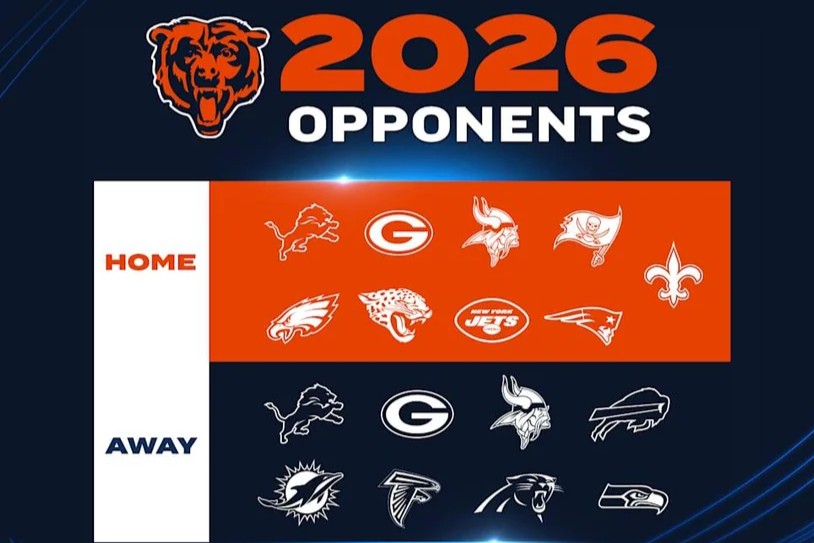
The Chicago Bears wind up with the hardest schedule in the NFL based on being the NFC North division champion – which automatically puts them on a collision course with the Seattle Seahawks and the Philadelphia Eagles. But they also have to face the ENTIRE AFC East this year which means going up against the New England Patriots and the Buffalo Bills. Their interconference opponent for 2026 is the Jacksonville Jaguars.
That’s already five games against teams that had at least 11 wins last year :
Seahawks (Super Bowl LX winners), Eagles, Patriots, Bills, Jaguars — before you count the two each against Detroit, Green Bay, and Minnesota.
After winning the NFC North for the first time since 2020, the Bears were handed the league’s sixth-hardest schedule in ’26. They’ll open the season on the road to take on the Panthers in Week 1 before a seven-week stretch that features contests against the Vikings, Eagles, Packers, Seahawks and Patriots. The back-half of their schedule, meanwhile, doesn’t provide much relief, as they’ll take on the Bills, Green Bay, the Lions and Minnesota over the final four weeks of the campaign.
Why the Lions Get the Pansy Run
Detroit drops to 27th in traditional SOS and #1-easiest in projected because they finished below the rest of the division in 2025 and drew the corresponding place-based rotation. They get the easier 2025-record cross-conference draws and avoid a first-place schedule’s extra teeth. The projected metric likes them even more because they’re forecast to play the highest pace of teams Vegas thinks won’t be very good in 2026.
The Verdict
Hardest: Bears, by a whole fucking lot. They’re #1 traditional and 6th projected — the only NFC North team in the top ten on both lists. The first six weeks include road trips to Carolina, Buffalo, and Washington, plus Philadelphia and Seattle at home, and the final four feature Bills/Packers/Lions/Vikings. There is no soft stretch. Harder the RoK in Vietnam.
Easiest: Lions, by a mile. They’re 27th traditional and #1 projected — the only NFC North team comfortably in the bottom ten on either list, and the only team in the entire NFL with the #1 projected ranking for ease of schedule.
And, of course, every NFC North team plays every other one twice, so a meaningful chunk of each team’s SOS is shared. The differentiation comes from cross-conference and place-based rotations — and that’s where the Bears got incredibly punished for winning the division and the Lions got rewarded for not.
In which a billionaire family threatens to run away from home as the rest of us are asked to be sad about it
Let’s start with the part the graphic in your feed is trying very hard to keep you from noticing. The Chicago Bears did not announce that they are moving to Indiana. They announced that their board of directors voted to advance — that lovely, load-bearing little verb — a stadium “development project” in Hammond, with the exact site to be selected. No site. No shovels. No closing date. A vote to keep walking toward a thing they have been walking toward, then away from, then toward again, for three years running.
You know who said as much? The Bears’ own friends in Springfield. State Rep. Kam Buckner, who has been doing the actual work of trying to keep the team, said Kevin Warren called him the morning of the announcement to promise he’d keep talking about an Illinois stadium, and that the statement is — Buckner’s word — less definitive than the one the Bears issued back in February. State Sen. Bill Cunningham said flatly it isn’t fundamentally different from the February version either. So the franchise issued a press release announcing that it has the same feelings it had four months ago, dressed it in a board vote plus a team logo, and a whole genre of guys who think they can read a balance sheet because they own a pickup truck took it as a divorce decree.
It isn’t a divorce decree. It’s a screenager standing in the doorway with a bloated backpack, announcing to the kitchen that this time he really means it, he’s going to go live at his friend’s house in Indiana where they actually appreciate him. And the family — the State of Illinois — has finally, blessedly, learned the correct response, which is to keep eating dinner.
What the McCaskeys are actually mad about
Here is the thing nobody on the angry side of the blog wants to say out loud: this is a tantrum, and we know exactly what it’s about. The Illinois legislature wrapped its spring session without handing the Bears the property-tax “certainty” — the windfall, the assurance, the blank-ish check — that the ownership group wanted. So George McCaskey and Kevin Warren, with the moneyed comfort of minority owners like Pat Ryan behind them, did the only thing a frustrated heir knows how to do when the grown-ups won’t write the number he asked for. They stomped. Publicly. In a press release written by someone who has clearly never met the South Side of Chicago.
Because read the language again, slowly, and try not to laugh. A stadium in Hammond, they tell us, will “transform the region, connecting Northwest Indiana to the South Side of Chicago through the Loop and across neighborhoods and suburbs stretching north of the city.” It will “bring Chicagoland together.” This is the prose of a man who has been told the South Side exists but has never had a reason to drive through it. The South Side does not get connected to a stadium in Hammond. The South Side gets to watch the parking economy, the concession jobs, the game-day money that at least sprayed a few dollars onto the people who set up lots and worked the stands at Soldier Field — gets to watch all of it drive across the state line and land in Lake County, Indiana. You are not enriching the South Side of Chicago. You are trading poor people in Chicago for poor people in Munster and calling it regional synergy.
The honeymoon, then the bill
Now to Indiana, which is doing the most embarrassing thing in this entire saga, and that’s a competitive field. Governor Mike Braun, a man visibly thrilled to dance on Pritzker’s grave several years before anyone has died, welcomed the Bears with “Hoosiers, help me welcome the Chicago Bears to our great state!” and a promise of a partnership “as strong as the ’85 Bears defense.” Set aside that invoking a defense from forty-one years ago to sell a stadium that won’t open until 2031 is its own quiet tragedy. Focus on the structure of the deal he’s so proud of.
Indiana has dangled up to a billion dollars in incentives to land this thing. A billion dollars of Hoosier money, committed by Republican legislators who will cut every ribbon and then be conveniently term-limited or retired by the time the real bills arrive. Because the bills will arrive. The site is industrial Northwest Indiana — Wolf Lake, the kind of acreage that comes with environmental reports, remediation questions, and a zoning gauntlet that has a long, documented habit of turning a published budget into an opening bid. My over-under on what this actually costs by the time it’s playable, with cleanup and overruns priced in, is well north of what’s on any current slide. Put your own number on it. Just make it bigger than theirs.
And when the overruns hit — when the remediation comes in heavy, when the traffic studies demand infrastructure nobody budgeted, when the “world-class” renderings meet a marsh — who’s holding the residual? Not the McCaskeys. Not Illinois. Indiana taxpayers, and Colts fans who never asked for a second team to split their state’s football oxygen and never wanted to subsidize one. The honeymoon lasts exactly until the first invoice the renderings didn’t account for. Then it’s a five-to-eight-year boondoggle with a governor’s name on the groundbreaking and somebody else’s name on the workout.
The part where Illinois quietly wins
So let’s retire the bit where this proves Chicago and Springfield are corrupt and broke. Run the logic. The “corrupt Democrats” you’ve been told to despise are the ones who declined to set public money on fire to keep a billionaire’s franchise from decamping. The fiscally responsible move — the genuinely conservative move, if any of the people cheering this still remembered what that word meant — was to refuse the blank check. Illinois did that. Illinois looked at a project with a price tag that only goes one direction and said: not on our books.
And here’s the dirty secret the McCaskeys’ press release is built to obscure: if the Bears actually go, Illinois loses a narrative and keeps its balance sheet. It eats a news cycle of “Illinois lost the Bears” and in exchange never owes a dime on a domed monument to one family’s tax grievance. The fans don’t even lose the team — Hammond is a twenty-minute drive south of Soldier Field. You can still get there. You can still tailgate. You can still watch them go 8-9 in a new building.
Which brings me to the crude version, for the crude room: this is the rare arrangement where you get to sleep with the supermodel ten times a year and never have to date her. No anniversary. No “we need to talk about the kitchen renovation.” No co-signing the mortgage on a place near Gary that’s going to smell like Gary. Indiana just got down on one knee. Let them. Let them pay her expenses for the next three decades while Chicagoland drives down on Sundays, enjoys the view, and drives home to a city that didn’t put a cent toward the privilege.
So: do I want them to go?
God, yes. Go. Please go. Take the marsh. Take the billion in incentives that becomes two. Take the zoning fights, environmental delays, the Colts fans’ resentment and the governor who’ll have moved on to his next photo op by the time the first beam goes crooked. Take all of it.
Because this statement means precisely nothing — it’s a board vote attached to a feeling, less binding than the one before it, with no site and a guy calling Springfield the same morning to keep the door propped. But on the off chance the tantrum hardens into a moving van? Break out the popcorn. The most entertaining thing the Bears have produced in a decade won’t happen on the field. It’ll happen on a financing spreadsheet in Indianapolis, in real time, for the next five to eight years.
You will want to read Pt. 1 and 2 before reading this article.
Aggregating the data from sources is a big PITA and so something has to go, and that is me summarizing too much. What I will say is that Pt. 1 looks at the high level deficit and see how many standard deviations we were off from other teams. Pt. 2 is looking at crews and seeing if all crews or some crews contributed to the Bears being bad.
Last article, I mentioned that Ben Johnson talked last camp (his 1st camp) about the culture and all the talk was how he was gonna be the Caleb whisperer, and for the most part, Caleb became a better QB under BJ. But that the teams’s OL woes kepts at him, and how he didn’t implement his full suite of tricks, formations and isolated mismatches. And that the Bears were, again, the lowest team in the league at getting flags thrown on their opponents. What we found was contra-examples of ref crews who seemed to be pro-Bears, but many krews called few penalties against Bears oppo.
My speculation is that for many years, Nagy and then Floose – Jussie back there – it was amazing to watch them even FIELD an offense. When a hobbled Darnell Mooney is your deep threat, and your OL has Jussie running for his life exactly 2 seconds after each snap, yeah, you ain’t getting a lot of DPI. You need a pocket to begin with to get roughing the passer.
I also stated that, organization wide, the Bears were a historically inept organization. Kevin Byard, on the Thanksgiving day meltdown, threw a water bottle at Floose’s head when he tried to address the team after the game. A bad analyst would state that Floose lost the team that day. A good analyst would state that Floose never had the team to begin with. Nobody bought in on that guy. Did you see Hard Knocks? Caleb is openly rolling his eyes having to listen to that guy, that Poles asked the HBO crew for shots of Floose looking thoughtfully at playbooks. As if.
So, to really bury this thing, we need some things. Bears against per game / crew non-Bears baseline: 1.00x Bears benefit per game / crew non-Bears baseline: 0.79x
The Bears get penalized at exactly the league-average rate by these same crews. They draw 21% fewer flags on their opponents than those same crews call on other teams’ opponents. The “flag-prone Bears” hypothesis is dead. The deficit lives entirely on the benefit side.
Per-crew breakdown — sorted by Ben/Base ratio (lowest = most asymmetric against Bears):
Crew BG Crew_G Baseline Agst/g Ben/g Agst/x Ben/x Scott Novak 5 66 46.06 56.40 21.00 1.22 0.46 Ron Torbert 4 69 51.30 54.50 23.75 1.06 0.46 Brad Rogers 6 65 53.36 46.17 29.17 0.87 0.55 John Hussey 4 67 46.87 55.25 27.50 1.18 0.59 Tra Blake 3 48 50.14 45.67 30.00 0.91 0.60 Alex Kemp 2 69 51.28 90.50 32.00 1.76 0.62 Shawn Hochuli 2 68 52.95 32.00 37.50 0.60 0.71 Alex Moore 2 16 64.86 61.50 47.50 0.95 0.73 Carl Cheffers 6 68 49.61 41.50 38.33 0.84 0.77 Clete Blakeman 5 68 50.88 49.80 40.80 0.98 0.80 Bill Vinovich 2 69 44.81 39.00 39.50 0.87 0.88 Adrian Hill 7 65 52.91 37.29 48.71 0.70 0.92 Clay Martin 5 68 48.10 60.00 45.80 1.25 0.95 Shawn Smith 2 68 47.34 67.00 47.50 1.42 1.00 Brad Allen 5 66 43.83 22.60 45.00 0.52 1.03 Land Clark 4 66 46.73 55.25 49.50 1.18 1.06 Alan Eck 3 48 45.01 79.00 48.00 1.76 1.07 Craig Wrolstad 3 69 47.61 42.67 56.67 0.90 1.19
Sign tests on the new metrics Bears Agst > crew baseline: 8 of 18 crews (p = 0.76) ← right at chance Bears Ben < crew baseline: 13 of 18 crews (p = 0.048) ← directional
This is the real finding.
What the test was supposed to distinguish:
Flag-prone Bears → Agst > 1, Ben ≈ 1 (both teams take normal flags from these crews; Bears just commit more)
Anti-Bears bias → Agst > 1 AND Ben < 1 (asymmetric on both sides)
Bears get fewer opponent flags specifically → Agst ≈ 1, Ben < 1 (asymmetric only on the benefit side)
The data shows the third pattern, decisively. The Bears commit penalties at the same rate every other team does under these crews. The deficit is entirely about opponents not getting flagged when playing them. That kills the lazy “Bears just take a lot of flags” story — it’s empirically wrong.
Crews where the asymmetry is strongest (sample size matters):
Scott Novak (5 games): 0.46x benefit. His non-Bears games average 46 yds against per team; his Bears games give Chicago 21 yds of opponent calls per game.
Brad Rogers (6 games): 0.55x benefit. Calls fewer opponent penalties on Bears’ opponents than on others’ opponents.
John Hussey (4 games): 0.59x benefit, 1.18x against — the only crew showing the textbook two-sided pattern at meaningful sample size.
Adrian Hill (7 games): 0.92x benefit but only 0.70x against — actually treats Bears slightly favorably on the benefit side, and unusually leniently on the penalty side.
Brad Allen (5 games, retired after ’23): 1.03x benefit, 0.52x against — he was actively the most pro-Bears crew in the league before he left.
What this means for the bias hypothesis.
With the flag-prone-team alternative now empirically dead, the surviving non-bias explanations are scheme/personnel:
Bears defense doesn’t induce opponent penalties — Bears don’t pressure QBs in ways that trigger holding/false-start rates from opposing OLs. Possible – if you have a quiet front seven. Did the Bears have a poor front seven these years? Ask Waffle.
Bears offense doesn’t draw DPI — fewer deep shots or contested catches, so opposing DBs aren’t put in flag-drawing situations. Plausible for Fields/Bagent/Caleb-rookie eras; harder to credit for Ben Johnson’s 2025 attack.
Bears don’t play teams that commit a lot of penalties — schedule effect. Plausible but the NFC North includes Minnesota, the most-flagged opponent in the league. So let’s toss that one.
Can you give a bitch a break?
Sure. The 0.79x aggregate is striking enough that some combination of those factors has to be doing real work, OR there’s a genuine officiating tilt. Updated Bayesian: with prior 5%, P(asymmetric pattern | bias) ≈ 0.6, P(asymmetric pattern | scheme effects) ≈ 0.20:
You have names now, you can hold onto “the Bears specifically don’t draw flags on their opponents when these particular crews are calling the game,” and that’s a much more salty question. But what you cannot do is show it’s anything more than those crews having a bias towards their back judges, and looking for DPI. We know that the NFL keeps changing what it wants with regards to DPI and how each crew is choosing to implement that across all games is probably the story. Not that the Bears get fucked.
Did we sink the Orca? Fuck no. What would the NFL be without third rate journos chumming the water for cheap engagement? Making wild claims that analysis does not support?
Roughly 14% on bias — modest update, because scheme effects remain a credible explanation for opponents-only deficits. And that’s where I fall. I fall on the team having a shit OL, an anemic DL; the swing is not across all crews. A WIDE variation exists, but when you put in the fix, maybe Goodell only bribes a few crews. If you want to hang on to the anti-Bears argument with your fingernails, you have enough data to die on that hill. But I don’t think so.
The next test, which I am not doing because now this is getting to be real work, would be against-side breakdowns by penalty type. If Bears’ deficit in opponent DPI calls specifically tracks with their offensive air-yards profile, scheme wins. If it doesn’t track — if Bears get short-changed on garden-variety opponent holding and false starts that aren’t scheme-dependent — then bias gets harder to explain away. I am pretty certain that were I to dig further into that hole, I would not find that.
Well, analysis done. Nothing stands out, esp. when you compare the crews to how they behave across the league. There is no there there. Would it be fun if there was? Maybe.
But I prefer the narrative that George is just a massive bonehead and good coaches just didn’t want to come here until Poles realized he was on his way out unless he convinced them to open the checkbook for a Ben Johnson. Which he did. He used Warren to tie to the move. It was savvy politics. Bears need to be a playoff team to help the case w. the Illinois legislature. Being an inept doormat had run it’s course. If they were competent they would have hired real head coaches instead of Trestman and Nagy. And now Ben Johnson is working towards a team that CAN draw DPI and false starts. Well, more on the DPI, not investing anything in the front seven is going to do nothing for drawing false starts.
Conclusion:
I made my arguments, showed that there is a statistical residual effect that crap journos can point to, but there are many other contradictory truths here that are more suggestive of a deeper problem that NFL officating has, which is that krews are not consistently applying standards to DPI. Is this news, really? Because any true football fan has known this for years. Let me wrap up the findings then, with the risk-reward ratio. If that does not dispel the story then nothing will and you may want to join Irish at breaking into Area 51 because conspiracy is just your groove dude, get a Q-Anon tshirt.
Here is what you have to believe to think this is a real directive: The NFL risk – if any of these krews,made up of SEVEN men plus a dedicated reply official tied to that crew in New York – if any of those guys get a hankering to talk to the Guardian or Intercept about this, you blow the league up. Goodell better have a Deadpool class assassin at the ready since fucking a major market like Chicago will gain you all kinds of 2nd rate journalists picking up the story once the first-rate ones open that gate.
The reward: One flag per game. Either holding on the oppo OL or OPI on their wideouts. You have to imagine a conversation that singles out 10 of 15 crews, because the NFL psych profile won’t risk it on the other five, and you say to them “don’t call MORE penalties on the Bears, just DON’T call one penalty on their opponents that you otherwise would have. Don’t go more than one, or the stats will start to look too bad, just one flag and then go back to being a fair ref. Maybe you just need the line judge or the back judge and not the whole crew. You have heard of point shaving, this is penalty shaving.
What does that buy you in terms of W-L? A single flag? Almost nothing. It’s so improbable to change a game the math isn’t worth showing. So, you risk the state of the whole league to just, perhaps, do a 2nd order point shave? Wouldn’t it be easier to just Art Schliester that shit and get to a QB who needs money? Or a RB? Just about any player is a better risk than a ref, who isn’t paid that well, may be a lawyer himself in real life, and is likely to be much more savvy about leaking the story? Or can we just say that the Bears didn’t draw holding because the DL was not that good at getting sacks? Or the Bears OL didn’t get DPI because for alot of that time their QB was basically another running back? We live in insane times where all manner of insane conspiracies get chummed. It’s sad that it’s coming from people who hold themselves out as experts, because their “expertise” is shit.
Last article we looked at Warren Sharp and Kristin Tanis assertion that, according to Tanis, the NFL is going out of it’s way to fuck the Bears over. They assertively postulated that the what exists, with no discussion on a possible why. They hate the McCaskeys? They are angry about the team not going to the Ryan family? Nobody is talking about what would be a massive scandal for the NFL, that they conspired to shit on a major market and a very popular team and keep them down.
So, what’s going on? Because the net effect of this chum in the water is that it exonerates the McCaskey family for years of utter incompetence as owners. In the week that followed Floose’s Thanksgiving Day meltdown, people like Colin Cowerd let the veil slip and said what Chicagoans have known for years – Ditka was right. The McCaskeys suck. They hired shit coaches, shit staff. Jeff spent years talking about what a viper pit that Halas Hall was. Because it was all true.
Saying the NFL hates the Bears feels very propaganda, it feels like a few low life journos on the interwebz just throw that into the water and give Ginny and her boys a great big pass. So that’s my take. But, in order to really push this nonsense off, we are going to go down the Neil DeGrasse Tyson MasterClass path and teach a bit about critical thinking. And that’s to say, give what you may think is bullshit a full shrift.
Last article I calculated the SD, Mean, z-score, p-score and looked at the bias, and found what I thought may be reasonable explanations why the Bears opponents don’t get as many penalties as other teams. Why they are always last in opponent yards flagged. Is the fix in? The refs are told, “yeah dude, if a team is playing the Bears, let them get away with some shit. Let them hold, don’t flag them for false starts, just let them go so that the Bears get fucked.” And we found that over the life of the thing, the Bears are down about a single flag, a 10 yard penalty. Had one more flag been called per game across 4 seasons, this would not be a conversation. But that’s enough to look at it, and the data there – at the aggregate level, says wow – Bears suck at drawing penalties, but to really really know if this is a thing the refs are told to do, it helps to know if it was all the krews or just some. And that takes work from nflpenalties.com.
So, to rise to the metaphor, we have spears in our back and two yellow barrels pulling us up, but we have no choice – if we are gonna kill the crew of the Orca we gotta submerge, we gotta go deep.
Bears 2025 game-level data with crews:
Wk Opp Crew Agst Benef Net W1 vs MIN Alan Eck 127 50 -77 W2 @ DET Land Clark 50 28 -22 W3 vs DAL Clay Martin 41 25 -16 W4 @ LV Adrian Hill 60 36 -24 W6 @ WAS Alex Moore 84 40 -44 W7 vs NO Scott Novak 92 30 -62 W8 @ BAL Shawn Smith 79 45 -34 W9 @ CIN Clete Blakeman 43 49 +6 W10 vs NYG Adrian Hill 25 69 +44 W11 @ MIN Brad Rogers 40 15 -25 W12 vs PIT John Hussey 83 41 -42 W13 @ PHI Carl Cheffers 35 44 +9 W14 @ GB Craig Wrolstad 17 55 +38 W15 vs CLE Ron Torbert 25 21 -4 W16 vs GB Alex Kemp 105 40 -65 W17 @ SF Alex Moore 39 55 +16 W18 vs DET Brad Rogers 25 35 +10 WC vs GB Adrian Hill 5 65 +60 Div vs LAR Shawn Hochuli 24 5 -19 999 748 -251
Aggregated to 15 distinct crews: Crew G Net Net/g Alan Eck 1 -77 -77.0 Alex Kemp 1 -65 -65.0 Scott Novak 1 -62 -62.0 John Hussey 1 -42 -42.0 Shawn Smith 1 -34 -34.0 Land Clark 1 -22 -22.0 Shawn Hochuli 1 -19 -19.0 Clay Martin 1 -16 -16.0 Alex Moore 2 -28 -14.0 Brad Rogers 2 -15 -7.5 Ron Torbert 1 -4 -4.0 Clete Blakeman 1 +6 +6.0 Carl Cheffers 1 +9 +9.0 Craig Wrolstad 1 +38 +38.0 Adrian Hill 3 +80 +26.7
What the breakdown actually tells you:
The Bears were net negative under 11 of 15 crews. Sign test under H0 of 50/50 per crew: one-sided p = 0.059. Game-level (12 of 19 negative): p = 0.18. Borderline at the crew level, not significant at the game level.
The pattern is spread across crews rather than concentrated, which is the bias-consistent shape — but with the obvious problem that 12 of the 15 crews only worked a single Bears game, so each “data point” is one game’s noise. You cannot distinguish “Alan Eck has it in for Chicago” from “Week 1 was just a flag-fest” with n=1.
The most interesting signal cuts the other direction: Adrian Hill worked three Bears games (W4, W10, Wild Card vs GB) and his crew was hugely positive for Chicago — net +80 yards, averaging +27/game. If the league were systematically tilted against Chicago, you’d expect no crew to swing that positive over three games. That single data point is enough to make a “uniform anti-Bears bias” hypothesis hard to defend; it shifts the explanation toward “specific crews have specific tendencies that happened to disfavor Chicago in 2025.” Which is a much weaker claim and frankly an unfalsifiable one without crew-level data across many seasons. We must leave the n=1 noise floor, like Jaws must jam his nose into the wooden planks of the Orca despite the pain. We have found a crew in 2025 that cut Bears-positive. Maybe he didn’t get the memo. Maybe he’s secretly born in Joliet.
Does not matter. If Adrian Hill stays positive for the Bears across all four seasons and Alan Eck stays negative, you’ve got something real and specific. If everyone regresses to the mean across years, the 2025 spread was just variance and the cumulative Bears deficit needs a different explanation.
Cumulative crew-level net (Beneficiary minus Against), Bears 2022–2025: Crew G Agst Benef Net Net/g Years Alex Kemp 2 181 64 -117 -58.5 23,25 Scott Novak 5 282 105 -177 -35.4 22-25 Alan Eck 3 237 144 -93 -31.0 23-25 Ron Torbert 4 218 95 -123 -30.8 22-25 John Hussey 4 221 110 -111 -27.8 22-25 Shawn Smith 2 134 95 -39 -19.5 24,25 Brad Rogers 6 277 175 -102 -17.0 22-25 Tra Blake 3 137 90 -47 -15.7 22-24 Clay Martin 5 300 229 -71 -14.2 22-25 Alex Moore 2 123 95 -28 -14.0 25 Clete Blakeman 5 249 204 -45 -9.0 22-25 Land Clark 4 221 198 -23 -5.8 22,24,25 Carl Cheffers 6 249 230 -19 -3.2 22-25 Bill Vinovich 2 78 79 +1 +0.5 23,24 Shawn Hochuli 2 64 75 +11 +5.5 22,25 Adrian Hill 7 261 341 +80 +11.4 22-25 Craig Wrolstad 3 128 170 +42 +14.0 22,23,25 Brad Allen 5 113 225 +112 +22.4 22-24 Sign Tests:
Crew level: 13 of 18 crews negative, 5 positive → one-sided p = 0.048 Game level: 45 of 70 games negative, 24 positive → one-sided p = 0.0077 Year-over-year persistence (the more diagnostic question):
Crew 2022 2023 2024 2025 John Hussey -5.0(1) -27.0(1) -37.0(1) -42.0(1) ← all 4 negative, getting worse Brad Rogers -4.5(2) -38.0(1) -40.0(1) -7.5(2) ← all 4 negative Scott Novak -43.0(1) -37.0(2) +2.0(1) -62.0(1) ← 3 of 4 negative Ron Torbert -54.0(1) -66.0(1) +1.0(1) -4.0(1) ← 3 of 4 negative Carl Cheffers +23.5(2) -28.5(2) -18.0(1) +9.0(1) ← mixed Brad Allen +8.0(2) +31.5(2) +33.0(1) – ← all 3 positive (retired ’24) Adrian Hill -6.5(2) -40.0(1) +53.0(1) +26.7(3) ← flipped from neg to strong pos Craig Wrolstad -25.0(1) +29.0(1) – +38.0(1) ← mostly positive
What this actually shows.
The crew-level sign test is borderline (p = 0.048). Game level is solidly significant (p = 0.008). Both consistent with the cumulative finding — the Bears are net-flagged-against across most of the league’s officiating, not just by a few crews.
But the per-crew sample sizes are still ugly. Most crews worked 2–6 Bears games over four years; the standard error on a single game’s net is ~50 yards, so even Hussey’s −27.8/g across four games has a 95% CI that crosses zero. You cannot, with this dataset alone, say “Hussey calls Bears games unfairly” with statistical confidence — you can only say his four data points all happen to be negative. That’s interesting but it’s not proof. Maybe he’s just a bad ref.
The two findings that meaningfully update the bias hypothesis, in opposite directions:
Spread-out negative pattern is real. 13 of 18 crews coming out negative isn’t what you’d see from a one-or-two-bad-crews story. It looks like the Bears get net-flagged against by most of the league. That’s the bias-consistent pattern or the structurally-flag-heavy-team pattern; both predict this.
Brad Allen’s three years are the killer counterargument to bias. All three of his Bears games came in clean +30s. Adrian Hill flipped from negative to strong positive over time. Wrolstad is positive. If the league were systematically tilted, you should see no crew running consistently +20 or +30 net for Chicago. The fact that you do — and that “+22.4/g” Allen exists in the same dataset as “−27.8/g” Hussey — is hard to reconcile with uniform institutional bias. It’s much more consistent with crews having different general flag-throwing tendencies, full stop, and the Bears being a flag-heavy team that gets hurt more by high-volume crews.
Let’s stop there, just for a moment. Last camp, how many times did you read that Ben Johnson brought the full camp to a stop. Huddled everyone up. He was seeing all manner of false starts, route confusion and guys not knowing what page they were on. He admitted he scaled back his offense. Is that consistent with a culture that sucks? A culture that had a lot of skating, a lot of dodging the hard mental work needed? Seemed that way to everyone at the time, because the consistent narrative was that BJ was changing the culture and making people accountable.
You, dear reader, are saying “oh GP, you pretentious fuck, you all but admitted your bias, and while there is a counterpoint crew, you just gave your own game away. You showed that there is a large group of crews that don’t like the Bears. McCaskey is exonerated! Let’s salute the brave denziens of Twatter/X with their ability to call out mass fuckery!”
Well.. hold on there Cowboy.
The cleanest test still missing.
What I haven’t done is compare each crew’s Bears-game numbers to that crew’s non-Bears numbers. If Hussey’s crew calls 50 against / 60 for in non-Bears games but 55 against / 27.5 for in Bears games, that’s anti-Bears. If Hussey’s crew calls 55 against / 28 for in every game they work, the Bears are just unlucky to draw the same crew four times. That’s the next layer of analysis, and it’s the one that would actually distinguish “Bears get unfairly flagged” from “Bears get a lot of flags and a few referee crews call a lot of flags.
That is for article three. Now… go get your shine box
Let’s begin this story where many stories start; somebody posted some shit on Twitter. Specifically, Warren Sharp stirred it up with this:
Now, if you chum the waters from the back of the Orca, sometimes you’re gonna need a bigger boat. Sometimes sharks appear. So let’s be a Great White, shall we, and take a big bite out of this. Because it started to get legs with this Tanis lady picking that ball up and running with it.
Tanis goes on to say, “Either the Bears have the worst luck in the history of history, or the NFL is going out of their way to screw over the bears (which seems most likely seeing how they were not awarded the comp picks when Cunningham was hired by ATL). Every team thinks the refs are screwing their team over. However there are stats that show it’s actually happening to the Bears. On a yearly basis. And you can’t say it’s coaching/play calling, bc there have been two (technically three) different head coaches for the bears in the last 4 years. “
Can you leave that alone? I decided not to. Bears Tax. It’s all that the regs on DBB and DBB2 ever talked about for years, how the NFL hates Chicago and how the Packers get their ring rimmed constantly, esp. in the 4th Q when the fix is sent in on carrier pigeon by Goodell himself. I mean, seriously, fuck that guy. FTP. All of it.
So, let’s preface first. There was a DBB reg named Data. Or that’s what we called him. Nice guy, Jeff at DBB used to let him guest post. He used to post “statistics” as conversation starters, and that was all well and good. His idea of statistics was to open up Excel and make a pivot table, and punch some information in, then draw a conclusion from said information, and the debate was on the way. Nice guy. It had no bearing on actual stats, but it was pat on the head nice. I offered to help him with actual statistical analysis, but he shooed me away (politely) and said that he was quite happy in his life doing his tables and drawing his conclusions, and not to mess with his Wizard of Oz magical ways. So, I did not.
But a Bears tax won’t be served by a pivot table. We need stats from Yahoo and we need to tranquilize this Lion and open it’s mouth and check it’s teeth. So, in case you were wondering, we shall now engage in ACTUAL STATISTICS.
GP calculating tip at restaurant for four separate parties
Our postulation: the NFL or given crews have it out for the Chicago Bears. That a Bears Tax exists, or are these just journalists who are bad at stats doing what the Twatter was made for: stirring the pot. Getting a big wooden spoon and swirling the shit until the scent attracts real sharks. Let’s take a bite of that swordfish on the line being towed. As Khan himself said, Sharp tasks me! He tasks me, and I shall have him!
Step 2 – We need a cross-team reference distribution, For each of the 32 teams I computed cumulative yds/game (total beneficiary yds ÷ total games over the four seasons). What do we see?
The two means differ by 0.04 because teams have different game counts (playoff teams play more). Use the unweighted x̄ as the location parameter for the cross-team distribution since the SD is also computed across teams. Step 3 – Z-Score z = (x_CHI – x̄) / s = (38.9143 – 48.6572) / 3.9431 = -2.4709 Step 4 – P-values
Bears weren’t pre-specified. We’re picking them because they’re the outlier. Correcting for 32 teams (i.e., asking “what’s P[some team this extreme]”):
P(any team z ≤ -2.47) = 1 – (1 – 0.006739)^32 = 0.1946 ≈ 1 in 5 Bonferroni upper bound = 32 × 0.006739 = 0.2157
Step 5 – Cumulative deficit interpretation.
Expected Bears yds at league rate = 70 × 48.6124 = 3,402.87 Actual Bears yds = 2,724 Deficit = 678.87 yds over 4 seasons = ~170 yds/season = ~10 yds/game
Step 6 – What is this test rejecting?
The cross-team SD of 3.94 includes both sampling noise and legitimate between-team variation (scheme, pace, QB style). So z = -2.47 against this SD says: “the Bears are far below where teams typically end up, including the noise of 70 games and the spread of 32 different football operations.” Rejecting at p = 0.007 means rejecting “all 32 teams have identical underlying penalty-drawing rates” — a null that was already false on inspection (Minnesota at 57.7, Bears at 38.9, both with 70 games).
It does not mean rejecting “no anti-Chicago referee bias.” So we must continue forward.
A more aggressive test using only sampling variance (treating per-game yds as iid within each team and ignoring between-team scheme effects) would give a smaller p, but the inferential gap to “bias” gets wider, not narrower, because more of the variance gets attributed to legitimate team differences.
Now we need a Bayesian wrapper on this: P(bias | data) = P(data | bias) × P(bias) / P(data) = P(data | bias) × P(bias) / [P(data|bias)P(bias) + P(data|¬bias)P(¬bias)]
If your prior P(systematic anti-Chicago bias) is 5%, and you generously assume P(z ≤ -2.47 | bias) = 0.50 vs. P(z ≤ -2.47 | no bias) = 0.195 (the look-elsewhere baseline — under “no bias” we still expect some team to be the outlier ~1 year in 5): Posterior = (0.50 × 0.05) / (0.50 × 0.05 + 0.195 × 0.95) = 0.025 / 0.21025 = 0.119
So the data moves the bias hypothesis from a 5% prior to ~12% posterior. Real movement, but nothing close to “proven.”
The data is moderately suggestive, not damning, and the dominant alternative explanation — that the Bears have run an anemic offense for most of this window and bad offenses don’t draw flags — costs nothing extra in plausibility.
Oh GP, you fucker, you say, sure… Jussie was a shitbird and could not run an offense. Eberflus was so ill-regarded that other teams could see into their setups and adjust. Floose running the Cowboys D in such an inept manner showed his scheme just didn’t get breaks. But what about Caleb? What about BJ? That Tanis broad, she was on it, was she not? She points out that the Bears tax runs between regimes! Ha ha! Checkmate! Take your math and shove it you Grey Poupon eating pretentious math ass!
Well… hold on there Cowboy.
2025 only: League mean 50.47 yds/g, SD 6.83, Bears 39.37. Bears z = −1.63, one-sided p = 0.052, look-elsewhere p = 0.82. So the single season isn’t statistically remarkable — the Bears were lowest, but only by 0.68 yds/g over Buffalo. What makes 2025 important isn’t the single-season significance; it’s that it removes the easiest counter-narrative.
The asymmetry signal in 2025 is the cleaner one:
Against/g Benef/g Net/g Bears 52.58 39.37 -13.21 Buffalo 50.26 40.05 -10.21 Denver 61.79 48.21 -13.58 Detroit 42.24 41.24 -1.00 SF 36.95 41.42 +4.47 LA Rams 34.55 51.55 +17.00
Yahoo has the 2025 Bears 6th in total yds/g (379.2) and 9th in PPG (25.9). I’ll grant top-10. Caleb’s 388 rushing yards is good-not-elite (Lamar’s typically 700–900) but the scramble-draws-flags mechanism is real. And the Bears threw 574 pass attempts — lots of dropbacks where DPI/holding could be called. So you’ve largely killed the “low pace / low pass volume” version of the alternative. What survives:
Scheme-specific: Ben Johnson’s offense is precise and quick-throw oriented — fewer extended plays, fewer deep shots, fewer of the situations that draw DPI and defensive holding. Detroit ran a similar offense and was 3rd lowest in 2025.
Sack rate: Bears took 24 sacks, well below average. Lower QB-hit volume = fewer roughing-the-passer chances. The Caleb-doesn’t-get-hit story works partly against the scramble-draws-flags story.
Pure noise on a one-season sample.Sorry but that’s what it is.
Tanis and her 2025 evidence kills the strongest version of the boring alternative (“Bears suck offensively, of course they don’t draw flags “). It does NOT kill the scheme-and-style version, and the look-elsewhere correction still applies to the cumulative case. If I redo the Bayes with prior 5%, P(data|bias) = 0.50, and revise P(data|no bias) down from 0.195 to maybe 0.12 (since the boring alternative is partly defanged):
You’re at ~18% posterior on bias. That’s three-and-a-half times the prior, but it’s still a minority position. The data is suggestive. To push it toward damning, the test you’d want is referee-crew breakdown — if the Bears’ deficit holds across all 17 crews, that’s hard to explain without bias; if it concentrates in three of them, you’ve got something more specific and frankly more interesting than “the league hates Chicago.” So, that is the rabbit hole we must go down in a future article. As Hippy likes to say, “where the fuck do you find this stuff?”
Per-game data with referee crews — pulled from the team-by-game pages:
These give every Bears game with the date, opponent, ref crew, count, yards — both for penalties against the Bears and for penalties against their opponents.
So, for article 1 I have tried to show that Jussie + Floose just made for bad years, and I cannot suss out a systemic bias from the data. No way some journos without a quant background can do it. Easier to chum the water than reel the shark in, isn’t it? It took a scuba tank and Quint’s old M1 Garand to finish that monster off. If you are gonna get out there in public and declare a Bears tax exists, then extraordinary claims require extraordinary proof. And so we shall venture forth looking for Part 2 Hypothesis, which we shall call the Billy Butcher hypothesis, being: “yeah, ok, but I bet some ref crews are rite cunts!” Onward we go.
The NFL’s Leverage: How They Can Actually Threaten McCaskeys
Relocation Vote — The Nuclear Option
Under the NFL’s relocation policy (last formalized after the Raiders/Rams/Chargers moves), a team cannot relocate without a 3/4 owner vote — 24 of 32 owners must approve. The league could simply tell the Bears: “We will whip the votes against you.” The McCaskeys know how this played out when Oakland and San Diego tried to block the Raiders and Chargers — owners are notoriously unsympathetic to teams that didn’t “exhaust local options.” The NFL could credibly argue the Bears haven’t done that, given Illinois keeps putting offers on the table.
The Relocation Fee
When the Rams, Raiders, and Chargers moved, they paid relocation fees in the range of $550M–$650M each. The NFL could signal they intend to impose a maximum fee — potentially north of a billion dollars given the Bears’ market size. Chicago is the #3 market in the country. Losing the Bears to Indiana (technically still the Chicagoland area, but still) would set a wildly destabilizing precedent. The fee alone could crater the financial math of the Hammond deal.
Stripping Marquee Events
The NFL controls Super Bowl bids, Pro Bowls, and Draft locations. A new Bears stadium is essentially being built around hosting Super Bowls and Final Fours — it’s core to Kevin Warren’s whole pitch. The league could quietly signal that a Hammond stadium, built partly as leverage against Illinois rather than through good-faith negotiation, won’t be in the Super Bowl rotation for years. That wrecks the revenue projections in the financing model.
“Chicago Bears” Name/Brand — The Soft Threat
This one is rarely discussed but has teeth: the NFL could raise the question of whether a team that moves to Hammond, Indiana can still be called the “Chicago Bears.” Technically the NFL controls the franchise, and while it’s never been fully litigated, the league pressured the Raiders to eventually return to Oakland branding history and the Chargers faced enormous blowback keeping “Los Angeles.” It’s unlikely to be a hard block, but the league could make the Bears’ identity in Indiana murky and uncomfortable — and the McCaskeys know the “Chicago Bears” brand is worth enormous amounts.
Scheduling Disadvantages / Primetime Leverage
Less formal but real — the NFL controls primetime slots. A team that just burned its #3 market on a controversial state-line hop could find itself getting far fewer Sunday/Monday night games. That’s TV revenue. It’s petty but it’s real.
“Exhaust Local Options” Requirement
The NFL’s relocation guidelines explicitly require teams to demonstrate they’ve made a good-faith effort to reach a stadium solution in their current market before the league will approve a move. The NFL could argue the Bears short-circuited the Illinois process — Illinois was reportedly close to a deal and the Bears themselves asked Springfield to pause the hearing on the megaproject bill to “tweak” it. If the Bears killed their own deal, the NFL has cover to say the good-faith standard wasn’t met.
OT: Stadium Update
State representative Kam Buckner, who has been spearheading negotiations on the stadium issues, joined 104.3 The Score’s Mully & Haugh on Friday to discuss the stadium bill, and he believes a resolution is going to come quickly. “As the old church folks used to say, ‘Soon and very soon,’” Buckner said when asked about a possible deadline. “I don’t know exactly when we’re going to get this done, but listen, when I say we’re on the punch list stuff, we are there. We got another day here in Springfield where we’re going to hammer some other things out. Next week is a big week for us…I think we’ll have some good news in short order.”
Welcome to Hammond, Indiana — Please Watch Your Step (and Your Air Quality)
Let’s talk about the Wolf Lake site, because nobody covering this story with knee pads seems to want to. The Bears’ preferred location — the Lost Marsh Golf Course near 129th Street and Calumet Avenue — is roughly 18 miles southeast of Soldier Field. It sits next to the BP Whiting Refinery, the largest oil refinery in the Midwest. It was built over an old industrial landfill. Drilling crews have already been out there flagging buried water and gas lines.
Wolf Lake itself has a history that would make even the most enthusiastic real estate agent wince. Gangsters used it as a body disposal site in the 1920s and 30s. It was the dumping ground for a murder victim in the infamous Leopold and Loeb case in 1924. And now, in 2026, Hammond Mayor Thomas McDermott Jr. stood before a committee and, reportedly choking up with emotion, declared it a “once-in-a-generation opportunity.” Maybe he was choking on the shit backing up in his colon.
He’s not wrong. It really is a once-in-a-generation opportunity — to commit a historic, billion-dollar environmental boondoggle.
The environmental remediation alone on a site like this — industrial landfill, proximity to a major refinery, underground pipelines, contaminated soil — could easily add hundreds of millions to the project cost. The Bears’ own “due diligence” is still ongoing. Nobody knows what’s actually down there yet. The Indiana bill doesn’t even nail down who pays for cost overruns. What starts as a $3 billion project has every hallmark of a $7-8 billion disaster in the making once you factor in cleanup, infrastructure, litigation, and the inevitable moment when someone finds something truly nasty underground. And when that bill comes due, you can bet the state of Indiana — and the taxpayers of Lake County — will be staring at it. See how eager they are when the Casinos tell them to eat it and pony up. Who knows, Trump may destroy the EPA by then and it’s a non-problem. Just make sure your health insurance is good before attending a game.
Indiana is committing roughly $1 billion in public funds, to be financed through a cocktail of admissions taxes, food-and-beverage taxes, and hotel taxes. Sound familiar? It should. It’s almost exactly the same structure as the Arlington Heights deal the Bears couldn’t get Illinois to finalize. Except it’s on a landfill. Next to a refinery. In a state that already has an NFL franchise in Indianapolis whose fans are now being asked to welcome a second team that will compete with them for everything from sponsorships to media attention.
Colts fans: how does Kevin’s dick taste?
The NFL Blackout Problem Nobody Is Talking About
Here’s something the excitement-drunk Hammond boosters and Bears beat reporters apparently haven’t gotten around to mentioning: the Chicago media market.
The Bears currently play in Chicago. Their entire fanbase — the people who buy tickets, the people who fill the stadium, the people who make home games sellouts — live in the Chicago metro area. Move the team 18 miles across a state line into Hammond, Indiana, and you have now placed the franchise outside the Chicago market for NFL broadcasting purposes.
Under NFL blackout rules, if games in Hammond don’t sell out, Chicago can no longer be blacked out — because Chicago isn’t in the team’s home market anymore. You’ve now created a situation where Bears fans in Chicago have every incentive to stay home and watch on TV rather than make the trek to Hammond. And if attendance struggles, the revenue projections underpinning the entire Indiana financing structure start to look like they were written on a cocktail napkin. In a casino.
Kevin Warren seems to have bet that Bears fans will follow the team anywhere. That is a fascinating assumption to make about a fanbase that has been historically loyal despite decades of organizational incompetence — but loyalty has limits. Driving into Indiana, past a refinery, to sit in a dome built on a landfill, to watch a team that no longer officially calls your city home? Some fans will do it. Many won’t. Chicago may show balls and petition the NFL to remove the city’s name from the team. A lawsuit they should easily win. Hammond Bears? Sounds like some shit microbrew.
George McCaskey: A Portrait in Incompetence — and Desperation
Let’s dispense with sympathy entirely and talk about what’s actually driving George McCaskey, because it isn’t football. It was never football.
Virginia McCaskey, the Bears’ matriarch and daughter of George Halas, did what wealthy patriarchs and matriarchs always do when they want to avoid estate taxes while keeping peace at the Thanksgiving table: she distributed ownership shares across the family. Thin slices — 3%, 4%, 5% here and there — handed out to children and grandchildren who, by and large, care about the Chicago Bears the way you care about a stock ticker. They don’t go to games. They don’t watch film. They watch their bank accounts.
Virginia is gone now. And those shareholders — the entitled, football-indifferent beneficiaries of the Halas family legacy — have made their position clear to George: generate cash flow or we sell. Not to just anyone, either. There are buyers circling. The Ryan family, among others, has the capital and the appetite to start quietly accumulating those minority shares until someone wakes up one morning and realizes the McCaskey era is over not with a dramatic sale but with a slow-motion death by a thousand small transactions. George was probably instructed by Virginia in her last days to not allow that to happen.
George McCaskey knows this. He knows the only thing standing between him and irrelevance is a revenue stream large enough to keep the restless shareholders fat and happy; exactly one thing generates that kind of cash flow fast enough to matter: a casino.
Not a stadium. A casino.
The “football town” vision — the restaurants, the retail, the hotels, the entertainment district — is the polite version of what this is actually about. The Bears have been in conversations about casino licensing as part of the Arlington Heights development for years. A stadium-adjacent casino, in a state with regulated gambling, attached to one of the NFL’s most historic franchises, in the Chicago metro area, would generate revenue that dwarfs anything the stadium itself produces. That’s the cash cow that keeps the fractious McCaskey shareholders from selling their slices to the highest bidder.
Which raises a question nobody in the compliant Bears media wants to ask: is the Hammond move real, or is it a pressure play designed to finally shake loose a casino license from Illinois that the state has been reluctant to grant? Because if Illinois caves — if they pass the infrastructure bill, freeze the property taxes, and throw in a casino license to keep the Bears in Arlington Heights — George McCaskey gets everything he needs to pacify his shareholders without Kevin Warren driving the franchise into a landfill.
And if it’s not a pressure play? If Warren genuinely wants Hammond? Then George McCaskey is a man so thoroughly outmaneuvered by his own President that he’s about to sacrifice the family’s century-old franchise on the altar of Kevin Warren’s ego and his own shareholders’ vacation home mortgages. George Halas is screaming at Virginia right now up in the clouds.
Image via Associated Press (AP)
Last year, the Matt Eberflus debacle — firing the head coach at halftime of a game the Bears were losing badly, one of the most publicly humiliating in-season firings in NFL history — prompted Colin Cowherd and others to name McCaskey among the worst owners in the league. The hiring of Ben Johnson and the emergence of Caleb Williams as a generational quarterback gave Bears fans genuine hope. But ask yourself: why did the Bears suddenly get competent on the field right when the franchise value conversation got interesting? A team with a generational QB, fresh off a playoff run, in a massive media market, is worth considerably more to a potential buyer than a perennial doormat. George McCaskey, whether by accident or design, presides over a franchise at peak valuation — right at the moment the stadium situation threatens to crater it.
He’s not a villain. He’s not clever enough to be a villain. He’s a man in over his head, surrounded by family members who want their money, manipulated by a President running his own agenda, and apparently unable to see that the exit Warren is steering toward leads directly off a cliff. Warren, a man the Big 10 couldn’t shed fast enough
Kevin Warren’s Long Con
Kevin Warren has been running a masterclass in institutional manipulation since he arrived. His open letter framing the Bears as benevolent private investors who are simply asking for “basic infrastructure” while demanding $850-950 million in public funds was, as one analyst put it, a semantic trick — and it worked beautifully on most of the Chicago sports media.
Now he’s done it again. The Bears were apparently in productive negotiations with Illinois as recently as Wednesday, February 19th — a three-hour session that Governor Pritzker described as “very positive.” The Bears then canceled Thursday’s committee hearing — which, according to Pritzker, was at the Bears’ request — and almost simultaneously dropped a statement praising Indiana’s SB27 as the most meaningful step forward in their stadium history. The blog that covers Springfield politics talks about Pritziker wanting things like affordability in ticket prices so average people can attend, and Warren responds by not showing up to meetings and putting power plays. Maybe Warren will scream “but the Dow is at 50,000!”
That is not negotiating in good faith. That is a man executing a plan while the other party thinks they’re having a conversation.
Whether Warren genuinely wants to be in Hammond or is using Indiana as a gun to Illinois’ head, the damage to the relationship with Illinois is real. And if he actually follows through with Hammond — landfill, refinery, Colts country, blackout rules, and all — then he will have maneuvered George McCaskey into presiding over a historic blunder that will define this franchise forever. And with the gravity of the decision, it’s really forever. The Chicago Bears are destroyed by a guy that was given the lowest approval by Big Ten athletic directors in Big 10 history.
George is handing him the matches. Kevin is already holding the gasoline.
The Hype Machine: Who’s Driving the Narrative?
Within minutes of the Indiana House Ways and Means Committee vote on Thursday, the Bears media ecosystem lit up like a pinball machine. Ben Devine of @Chicago_NFL — one of the more widely-followed Bears accounts — was declaring “The Chicago Bears are indeed moving to Northwest Indiana” and “Breaking: The Chicago Bears plan to commit $2 billion toward building their new stadium near Wolf Lake in Hammond, Indiana” before the ink was dry, before any site due diligence was complete, before anyone had answered the rather important question of who pays for cleaning up an industrial landfill next to the Midwest’s largest oil refinery.
“Indeed moving.” Not “may be moving.” Not “are signaling a move.” Indeed moving. Done deal. Pack your bags, Chicagoland.
Now, a few questions worth sitting with.
When a media personality with a large Bears following unilaterally declares a franchise relocation a fait accompli based on a committee vote and a carefully worded team statement that doesn’t actually commit to anything — is that journalism? Is it analysis? Or is it something else?
When that same breathless certainty is echoed almost simultaneously across multiple Bears-adjacent accounts, all amplifying the same narrative of inevitability — is that organic reaction? Or does it look, at least a little, like a coordinated pressure campaign designed to make Illinois lawmakers feel like the train has already left the station? It would be fun to look at Devine’s checking account and see if perhaps he’s on the dole.
Who benefits when Bears fans panic-share “they’re definitely leaving” posts that flood Springfield legislators’ inboxes and social feeds? Who benefits when the move feels so inevitable that Illinois is stampeded into a desperate, unfavorable deal — or, alternatively, when Illinois folds entirely and Warren gets everything he wanted?
Here’s what we know: Kevin Warren has already demonstrated that he is willing to use media framing as a negotiating weapon. His “open letter” reframed an $850 million public subsidy ask as a modest request for “basic infrastructure.” The Bears canceled an Illinois committee hearing — at their own request, per Pritzker — and within the same news cycle had a statement praising Indiana ready to go. That is not spontaneous. That is choreographed.
So when the same media cycle that amplifies Warren’s every press release starts declaring the move definitive, based on nothing more than a framework bill that doesn’t even specify financing terms — it’s worth asking who is writing the script, and who is simply reading it.
And this isn’t just a matter of Devine being enthusiastic or credulous. In December, he posted a claim that has since ricocheted across Bears social media as established fact: that Illinois is “demanding” the Bears pay for roads and infrastructure, framing it as something “even more rare” than a team privately funding its own stadium — as if Illinois were the aggressor shaking down a good-faith franchise.
This is not a matter of interpretation. It is factually inverted. It’s a lie and Devine is a liar.
Illinois is not demanding the Bears pay for infrastructure. Illinois is declining to pay $850 million in infrastructure costs for the Bears. Those are opposite things. The Bears chose a site that lacked existing infrastructure — in large part because that’s why the land was cheap — and are asking the state to cover the gap. Illinois saying “we’re not sure we want to spend $850 million on that” is not an unreasonable shakedown. It is a government weighing whether a near-billion-dollar expenditure is in the public interest, especially while taxpayers still owe $350 million on the 2003 Soldier Field renovations the Bears demanded and then abandoned.
Szymanski amplified it. Others amplified it further. By the time it reached the average Bears fan’s timeline, Illinois had been cast as the villain demanding the franchise privately fund its own roads — a cartoonishly unreasonable position that the state never actually took.
That’s how the machine works. Warren frames it. Devine broadcasts it. Szymanski validates it. The myth calcifies into conventional wisdom before anyone checks the receipts.
Devine may be entirely sincere. He may genuinely believe what he posts. But sincerity and accuracy are different things. And a media environment where “Bears insider” accounts race to validate Warren’s narrative without interrogating it — without mentioning the landfill, the refinery, the blackout rules, the Colts fans who didn’t ask for a roommate, the $7-8 billion remediation risk — isn’t covering the story. It’s becoming part of the story.
Bears fans deserve better than hype merchants dressed up as analysts. The franchise’s future is too important to be left to people whose loudest skill is hitting “post” fast.
FAFO, the MAGA Chorus, and the Ghost of Sweaty Teddy Phillips
Scroll through any Bears stadium comment section right now and you’ll find a particular species of intellectual wildlife repeating the same three syllables with the enthusiasm of someone who just learned what an acronym is: FAFO. Fuck around and find out. Illinois fucked around. Now they’re finding out.
It’s catchy. It’s also historically illiterate, politically motivated, and being fed to the internet knuckle-draggers by people who know exactly what they’re doing.
Let’s start with the history since the FAFO crowd apparently skipped it.
Twenty-plus years ago, the Bears — under their previous CEO Ted Phillips, a man so perspiration-prone that the nickname “Sweaty Teddy” wasn’t even mean, it was just accurate — took the late Mayor Richard M. Daley to the absolute woodshed. The 2002 Soldier Field renovation was a masterpiece of civic fleecing. The Bears got a brand new stadium shell dressed up in the bones of a historical landmark, financed through bonds backed by a 2% Chicago hotel tax. The city and state were told the debt would be manageable. The pandemic gutted hotel revenue. The hotel business never fully recovered. Chicago’s finances, never exactly a model of fiscal health, got worse.
As of early 2024, Illinois taxpayers still owe approximately $589 million in combined principal and interest on that renovation — $375 million in principal, $214 million in interest, with final payment due in 2032. The Bears’ lease at Soldier Field runs through 2033. Meaning: Illinois will finish paying for the Bears’ old stadium approximately one year before the Bears’ legal obligation to play there expires. At which point the Bears will presumably be gone, and Illinois will own a renovated historic venue with no anchor tenant and a $589 million receipt in the drawer.
Sweaty Teddy got his stadium. Stayed on as CEO for decades on the strength of that one negotiating win. And Chicago is still paying for it.
So when Governor Pritzker looks at the Bears coming back to the table with another demand — this time $850 million in infrastructure, a 40-year tax freeze, and a sales tax exemption on construction materials — and says we need to think carefully about this, he isn’t “fucking around.” He is a governor who has watched his state get fleeced once already, who is staring at $589 million in remaining debt from the last time Illinois played ball, and who has some elementary obligation to the taxpayers of his state not to simply bend over and say “thank you, may I have another.”
But here’s where it gets nakedly political. JB Pritzker is widely considered a serious contender for the 2028 Democratic presidential nomination. He’s wealthy, he’s governed a major blue state, and he has ambitions that extend well beyond Springfield. The Indiana Republican establishment — Governor Mike Braun, Speaker Todd Huston, and the rest — know this perfectly well. They are not primarily interested in football. They are interested in handing a potential 2028 Democratic presidential candidate a headline that reads: Pritzker Lost the Chicago Bears.
The FAFO chorus in the comment sections isn’t organic Bears fan outrage. It’s astroturfed GOP trolling with a football spin. Indiana Republicans get to look pro-business, pro-growth, and locally triumphant while simultaneously handing their national allies a weapon to use against a Democrat who might be running for president in two years. The Bears are a prop. Pritzker is the target. And the knuckle-draggers happily typing FAFO into YouTube comments are doing exactly what they’ve been primed to do — generate the appearance of popular momentum for a narrative someone else wrote.
None of them will drive to Hammond to watch a game on a Saturday night in January when it’s 14 degrees and the lake effect snow is coming sideways off Lake Michigan.
Halas Hall convincing Bear fans Indiana is actually part of Illinois
But they’ll type FAFO until their fingers fall off, because that’s free, and it’s fun, and someone upstream from them is very pleased that they’re doing it.
Pritzker isn’t a villain in this story. He’s a governor who looked at $589 million in outstanding debt from the last time Illinois gave the Bears what they wanted and concluded — reasonably — that the state should negotiate rather than capitulate. The fact that his political opponents have successfully reframed “fiscal responsibility” as “fucking around” is a testament to how completely Warren’s narrative operation has colonized the discourse.
Sweaty Teddy would be proud.
Illinois Isn’t Blameless
To be fair — and fairness requires acknowledging this — Illinois has been a willing participant in its own humiliation. Pritzker treated this as anything but a priority. The state’s response to years of Bears negotiations has been the governmental equivalent of “yeah, we’ll get to it.” The commercial property tax situation in Illinois is genuinely hostile to major development. The Arlington Heights deal dragged on for three years without resolution.
But none of that changes the fact that the Bears are now seriously contemplating building a $7+ billion stadium complex on an industrial landfill next to a refinery, in a state that has one NFL team already, financed by a public investment structure that is functionally identical to the deals they claimed were unworkable in Illinois — except with substantially more geological and environmental risk.
Illinois failed the Bears. The Bears are about to fail themselves.
The NFL Should Step In — And Chicago Should Play Hardball
Here is something that has gone almost entirely undiscussed in the breathless coverage of Hammond’s “once-in-a-generation opportunity”: the NFL has a vested interest in this deal not happening, and Roger Goodell should say so loudly.
The Chicago market is one of the most valuable in American sports. The Chicago Bears brand — one of the league’s founding franchises, the Monsters of the Midway, the team of Butkus and Payton and Urlacher — derives enormous value from its association with that city. Moving the franchise 18 miles across a state line to a landfill adjacent to a BP refinery in Hammond, Indiana does not make the Chicago Bears more valuable. It makes them a regional curiosity with an identity crisis, competing for attention in a market that now has to share its NFL loyalties with the Indianapolis Colts, who did not ask for a roommate and whose fanbase has been notably unenthusiastic about the prospect.
The league has intervened in stadium situations before. It has influence over where franchises land and how deals are structured. If the NFL is serious about protecting franchise values — and it is, because franchise values are the foundation of every owner’s net worth and every TV deal ever negotiated — then Goodell should be on the phone with Warren and McCaskey telling them that Hammond is not an acceptable outcome for one of the league’s flagship franchises.
But let’s say the league stays quiet, and Warren gets his way. Here’s a card Chicago hasn’t played yet, and should:
The city of Chicago owns the name.
Not legally, perhaps — trademark law is complicated and the Bears have held their marks for decades. But politically and culturally, “Chicago Bears” belongs to Chicago the way “New York Yankees” belongs to New York. If the Bears relocate to Hammond, Indiana, the city of Chicago should immediately and loudly challenge the franchise’s right to continue using the Chicago name. File the legal motions. Make it expensive. Make it embarrassing. Force the NFL and the Bears to litigate in public whether a team playing in Hammond, Indiana gets to trade on the identity and history of a city it just abandoned.
The Hammond Bears.
Say it out loud. Let that land. Think that works for Rodger Goodell? I don’t fucking think so.
Under NFL blackout rules, once the team plays in Hammond, Chicago is no longer the home market. The city cannot be blacked out for games that don’t sell out. Bears fans in Chicago — the actual Bears fans, the ones who grew up with this team, who remember the ’85 season, who endured decades of McMahon and Grossman and Cutler and the rest — will watch from their couches while a stadium built on an industrial landfill in Indiana fills with Indiana residents who six months ago had no interest in the Chicago Bears.
The Hammond Bears. Playing in a dome next to the BP Whiting Refinery. In a city with a population of 70,000. Trying to sell out a 60,000-seat stadium to a fanbase that mostly lives in a different state.
Roger Goodell should be embarrassed that this conversation is even happening. And if it happens, Chicago should make sure the NFL feels every inch of it.
Illinois still has until May 31st to pass legislation. It’s a long shot. The Bears, having now publicly and effusively praised Indiana and called SB27 the most meaningful step forward in their stadium efforts to date, would take a significant credibility hit by pivoting back to Springfield.
But meaningful step forward toward what, exactly? Toward a dome on a landfill next to the BP Whiting Refinery, in a city that borders Chicago but is definitionally not Chicago, in a state that didn’t ask for a second NFL franchise and whose existing NFL fanbase isn’t thrilled about sharing?
Bears fans deserve better than this. Caleb Williams deserves better than this. The franchise, at this particular moment in its history, has more on-field promise than it has had in decades.
And Kevin Warren appears to be steering it directly into Wolf Lake.
George McCaskey, for his part, will probably be surprised when it happens.
Kevin Warren Is Going to Burn It All Down — And George McCaskey Is Handing Him the Matches
Let’s get one thing straight before we dive in: what you’re watching right now isn’t a savvy negotiating tactic. It isn’t leverage. It isn’t a masterclass in business strategy. This is Kevin Warren we are talking about, a guy who was run out of the Big 10 for being an asshole.
What you’re watching is the slow-motion implosion of one of the most storied franchises in NFL history, orchestrated by a President who has confused activity with competence, while the owner nods along from the back seat like a golden retriever on the way to what he doesn’t know is the vet.
Welcome to the Chicago Bears, folks. Kevin Warren is going to become a generational pariah. George Halas will actually try and strangle him when Kevin finally reaches the pearly gates.
The Setup: How We Got Here
Three years ago, the Bears purchased the old Arlington Park horse racing grounds for $200 million. For a brief, shining moment, it looked like the franchise was finally serious about a real stadium — a proper home befitting a team with a century of history. Then the property tax negotiations with Illinois turned into a quagmire, Kevin Warren pivoted back toward the city, then away again, then floated a Soldier Field dome, then pointed at Indiana, and now here we are: the “most meaningful step forward” in Bears stadium history is apparently a golf course built on a landfill, in the shadow of the largest oil refinery in the Midwest.
Congratulations, Bears fans. You waited 40 years for this.
The “Tax Certainty” Con: How to Beg for a Subsidy Without Calling It One
Before we get to Hammond, it’s worth understanding exactly why the Arlington Heights deal collapsed — because the Bears’ PR operation has successfully muddied this water beyond recognition, and the truth is both simpler and more damning than anything read in the awful beat coverage. Damn I wish Adam Hoge would get George’s pecker out his mouth.
When the Bears bought the old Arlington Park property for $200 million, Arlington Heights assessed it the way any local government assesses any newly purchased property: at market value. The resulting tax bill came in around $9 million a year. The Bears negotiated it down to roughly $3 million. Fine. Property owners negotiate tax assessments. That’s legal and normal.
But then the Bears wanted more. Specifically, they wanted to lock in that discounted rate for 40 years — regardless of what they build on the land. I work in Texas and have heavy interaction with the Railroad Commission, who regulate the oil & gas industry down here. Watch the showLandman with Billy Bob and you will know, that proposal is a fucking joke. That gets you laughed out of the room and nobody takes you serious again. Warren is a clown.
And here’s why that matters. In every property tax system in America, if you improve your land, the value gets reassessed. Add a deck to your house, your taxes go up. It’s not punitive. It’s just how it works — the land is worth more because you made it worth more. The Bears are proposing to build not just a stadium but an entire entertainment district: restaurants, retail, hotels, possibly a casino. A football town. Each of those improvements would normally be assessed individually, generating tax revenue for local schools, police, fire departments, and yes — the infrastructure the development requires.
The Bears don’t want that. They want “tax certainty” — which is a beautifully crafted piece of PR language that means: we want to pay a fixed, discounted rate on this land no matter what we build on it, for four decades, so that our tax bill never reflects the actual value of what we’ve created. The city of Arlington Heights can go fuck itself; we want to make Pottersville from “It’s a Wonderful Life” look like a hick backwater town.
When you hear the Bears throw around numbers like $180-200 million in potential annual taxes, understand what that figure represents. That’s the projected total tax burden across all the improvements they plan to build — the stadium, the restaurants, the retail, the hotels, everything. It assumes the full buildout of their football utopia. The stadium alone wouldn’t generate anything close to that. The number is engineered to sound alarming while describing a completely normal outcome for a massive commercial development.
What the Bears are asking for, stripped of the euphemisms, is a 40-year tax break worth hundreds and hundreds of millions of dollars — money that won’t go to local schools, won’t fund the police and fire services their development will require, won’t pay for the roads and utilities that their patrons will use. That cost doesn’t disappear. It gets redistributed to everyone else in the tax base. Local residents will see their own property taxes rise to cover services that a Bears-adjacent entertainment district generates demand for, while the Bears themselves pay a rate frozen in the era when the land was an empty horse track.
That is a taxpayer subsidy. It doesn’t appear on any line item labeled “Bears subsidy.” It never will. But that’s what it is.
The state of Illinois understood this and pushed back. Arlington Heights, to its credit, said no. Kevin Warren’s response was to reframe a rejection of a sweetheart tax deal as the state being “obstreperous” and refusing to cooperate on basic infrastructure. The media, by and large, bought it. Hye guys at the Score 670 didn’t but the news people, or what’s left of the Trib and Sun Times, had nothing to say.
Nothing is preventing the Bears from negotiating their property taxes every year, just like every other property owner in Illinois. What they can’t do — what the state correctly refused to allow — is lock in a discounted rate on undeveloped land and carry it forward through a billion-dollar buildout for four decades. That’s not tax negotiation. That’s a blank check written by Illinois taxpayers, signed by people who’ll never see the Bears name on the bill. It’s bullshit, but it’s the kind of bullshit that the State of Indiana seems eager to take on. The lawmakers there must pass around jars of Vaseline to each other.