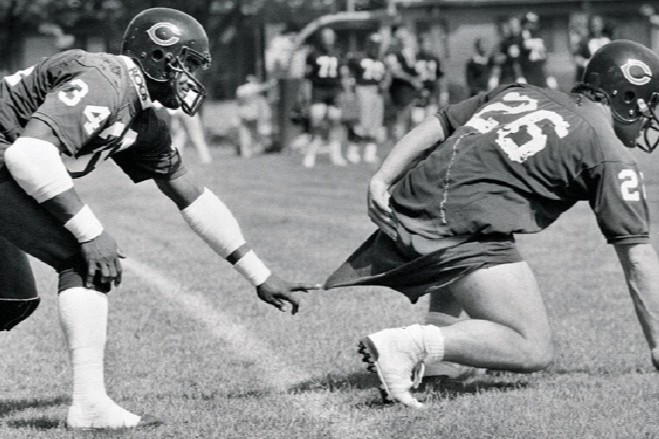

I can probably [and might] do a whole series on Smoking Jay Cutler. Jeff never really did a proper send off of him or that era. Cutler’s career ended not with a bang but a whimper. The forever “what-if” QB of our generation. He wasn’t Jeff George Lite like many detractors argue; however, no denying he never consistently lived up to his ceiling while his floor was Glennonesque [see, 4 INTs to DeAngelo Hall].
Anyhow, Bears aren’t the only ones left befuddled with blue-balls. Bronco fans too are left wondering, “WTF!”
A purgatory with no one home by GP ★★★½ out of ★★★★
Dir. Kane Parsons. Written by Will Soodik. Starring Chiwetel Ejiofor, Renate Reinsve, and Mark Duplass. A24.
There is a particular kind of dread that doesn’t announce itself with a monster. It comes instead from a room that was built to be full and isn’t — an office with the lights on and no one at the desks, a showroom staged for customers who never arrive, a corridor that goes on slightly too long. Backrooms, the feature debut of twenty-year-old Kane Parsons, is two hours of that feeling, and the remarkable thing is not that a internet-born horror premise survived its trip to the big screen. The remarkable thing is that the kid who made it understood his own material well enough to bury a metaphysical argument underneath the yellow fluorescents — and then had the discipline not to explain it.
The setup is almost insultingly modest. Clark (Chiwetel Ejiofor) is a failed architect who now owns a dying furniture store called Cap’n Clark’s Ottoman Empire, a man marinating in alcohol and a recent divorce, sleeping among his unsold inventory because his wife has thrown him out of the house he won’t stop reminding everyone he pays for. He sees a therapist, Dr. Mary Kline (Renate Reinsve). The electrical bill is too high. The lights flicker. And one night, in the basement, Clark finds a slit in the wall, pushes his hand through it, and falls into the place the internet has spent half a decade mythologizing: an apparently infinite expanse of liminal rooms, sourceless light, and furniture rendered slightly, sickeningly wrong.
(What follows discusses the film in full, ending and all. The spoiler architecture is best entered cold; consider this your slit in the wall.)
What elevates Backrooms above its found-footage ancestry is that Parsons and screenwriter Will Soodik refuse to decide what the place is. It plays two registers at once and never blinks. The Backrooms may be a literal alternate dimension — there is, after all, a shadowy institute called Async that has been mapping it since the late 1980s, complete with infrastructure and prior casualties. Or the Backrooms may be the externalized interior of a collapsing man. The film’s horror depends precisely on both being true simultaneously, and on the audience never being granted the mercy of choosing.
Consider the furniture. The space doesn’t contain random clutter; it is copying Clark’s world — his store, specifically — and doing it badly. His inventory comes back to him fused into piles, stacked in arrangements that obey no human logic, malformed. Clark himself supplies the film’s best description of the phenomenon: it’s like a drawing of a dog made by someone who has never seen a dog and is working only from a verbal description. The Backrooms reproduce from secondhand memory, so everything emerges a little incorrect. And here is the quiet brilliance of the conceit, the thing that makes a 2026 horror film feel like a nerve struck rather than a trend chased: this is the exact uncanniness of machine-generated imagery. A reality reconstituted by a process that has no comprehension of what it’s reconstituting. Parsons has made a film whose central monster is bad reproduction itself, and he did it without once saying the letters “AI.” A furniture salesman’s mediocre merchandise, copied by something that doesn’t understand furniture, in an infinite badly-designed building — the perfect hell, it turns out, for a man whose entire life was the failed design and furnishing of spaces.
Ejiofor is extraordinary, and the role asks for a specific and difficult arc: he has to be sympathetic enough that we follow him down, and then curdle. Clark’s tragedy, as Mary keeps gently surfacing in their sessions, is that he is a man who has already decided who ruined his life — the ex-wife, the career, the store, the world — anyone but the man telling the story. The Backrooms offer him a seductive rewrite. He is not a failure; he is an explorer. Not stuck; chosen. Not lost; the discoverer of the secret architecture beneath reality. Ejiofor lets us watch a wounded man fall in love with the one story that finally casts him as the hero, and then lets that love rot into something monstrous.
By the time he has dragged his two employees into the maze and lost them to it, and lured Mary in after, the curdle is complete. The film’s most disturbing sequence is also its thesis statement on Clark’s psychology. He has captured Mary, tied her to a chair, and he wants her to continue their therapy — to role-play, on demand, the argument that ended his marriage, so that this time he can win it. Therapy as hostage situation. The entire value of the discipline is that the therapist won’t simply validate you; Clark’s solution to that inconvenience is to remove, physically, her ability to refuse. He muses that you can eat the copies down here. He scalps a copy of his ex-wife and presses the hair onto Mary’s head, redecorating his therapist into his wife so he can keep arguing with a woman who left him — and then, naturally, segues into the old beer story, the grievances narrated as ever without arriving at his own name. It is the furniture-store logic applied to human beings: people as raw material, to be stripped, consumed, and rearranged into whatever the story needs. The horror isn’t that Clark is fighting anyone. It’s that he’s furnishing, and the people around him are the furniture.
Reinsve is the film’s other engine, and her arc is the inverse of Clark’s. She begins as the one who interprets — who listens, re-frames, contains, holds the patient’s loops at a safe professional distance from a chair across the room. Backrooms will not permit that distance to survive. She ends up inside the very maze she’d been trying to name from outside it, and the collapse of analytic remove into lived terror is its own kind of dread: what happens when someone else’s psychological labyrinth becomes real enough to trap you too. Her own trauma supplies the film’s second emotional architecture — a childhood home demolished to make way for a denser apartment complex, a mother lost to institutionalization, a fragment of cement she pries from the broken driveway bearing her own childhood handprint. She carries it in her pocket the entire film like a relic.
And then, in the climax, she doesn’t hold onto it. She beats it into the skull of the monster.
The climax is where the film earns its half-star above respectable. Mary, tied to the chair, finally stops absorbing and tells Clark the truth to his face: he blames everyone but himself, and that is why his wife left. And here is the cruelty of the construction — Clark hears it. He accepts it. He comes briefly to his senses and moves to free her. At the precise moment of his only genuine self-knowledge, the rage he has been incubating arrives in person to kill him. It takes the form of Captain Clark: a towering, deformed manifestation of his own fury, mutated out of the pirate mascot from his store’s own commercial, his offspring, his self given teeth. It tears into his throat in a tableau the film stages as a direct echo of Goya’s Saturn Devouring His Son. Growth and annihilation land on the same beat. The diagnosis is correct, the patient finally hears it, and the hearing is what finishes him. Self-knowledge as a thing that arrives too late and kills you on the way in.
The Goya reference rewards pressing on. Saturn devours his child out of terror of being overthrown — the creator destroying his creation to protect himself. Backrooms inverts it: here the son devours the father. The rage Clark built over years to shield his ego, the engine of “it’s everyone else’s fault,” could only sustain itself so long as he refused responsibility. The instant he drops the blame, it has nothing left to feed on but its maker. The consumer becomes the consumed — the logic of the place, and of his own life, closing on him at last.
Which brings us, inevitably, to Async, and to the film’s most unsettling performance, which belongs to a man being merely pleasant. Mark Duplass plays Phil, the Async scientist who watches all of this on surveillance monitors and files it as data. Async, we learn, was once an MRI company — a business built on imaging the inside of the human body — whose mission changed when it accidentally drilled into a place that images the inside of human memory. The same logic, scaled up and gone wrong. When Mary finally escapes the maze, she is caught not by a creature but by Async’s hazmat team and brought to Phil for interrogation, where he delivers the film’s only approximation of an explanation: the Backrooms function as an echo chamber for memory, which is why everyone and everything inside is an imperfect, misremembered copy. He notes, with mild conversational calm, that more doors are opening in the surrounding area. He declines to say what will happen to her once she’s finished answering his questions.
Duplass is doing something craftier than affable-guy-as-secret-villain. The banality is the menace. A man whose institute has watched people die in this place for thirty years, who clips it all into footage and maps and a tidy briefing, delivering it with the bland, slightly rambling reasonableness of a software onboarding — there is no relish, no monologue, no villain energy, just a pleasant person explaining the void’s filing system. Against Clark’s screaming personal collapse, Phil is the cold procedural counterweight: the institution that processes suffering into a spreadsheet. The horror is that he’s nice about it. And his explanation is engineered to dispel nothing — it gestures at a scientific framework precisely so the film never has to commit to literal-or-psychological. He names the mechanism without touching the mystery. The final shot, a slow pan down through the layers to reveal a new Still Life beginning to form, undercuts even his containment. Async believes it’s studying the Backrooms. The last image suggests the Backrooms are still working.
Sit with that ending and a genuinely vertiginous reading opens up, one a film this unassuming has no business supporting as well as it does. Strip the science-fiction veneer and what Async has drilled into is the architecture of purgatory — a liminal place, neither salvation nor damnation, where souls are detained and made to confront what they couldn’t resolve in life. The Backrooms even run on the right currency: memory, guilt, the unfinished. Clark is held until he reckons with himself, exactly as the doctrine promises. But the doctrine promises one more thing the film withholds: redemption. Purgatory is supposed to have an exit, a door marked up, suffering with a purpose that ends in purification. Here there is none. Clark confronts his truth and is devoured. Mary is not absolved; she is captured. No one ascends. What science found, in this reading, is the full apparatus of judgment and reckoning with the judge removed — a purgatory that is all process and no grace, all waiting room and no one behind the desk.
That is a more frightening proposition than hell, which at least implies a moral order. It is, if you want the philosophical company, the precise nightmare Nietzsche meant when he called the death of God a horror rather than a triumph: the structures of meaning hollowed out but still running, still demanding reckoning, out of sheer habit, with nothing at the end of them. It is also the exact thing Kant insisted we could not afford to believe — he argued we must postulate a moral order beyond death or the ethical life becomes incoherent, and Backrooms calls that bluff by handing us the afterlife he postulated and revealing it to be a memory-eating labyrinth with no accounting whatsoever. A horror film smuggling that question in under liminal-space aesthetics is, frankly, doing more than its genre asks of it.
And underneath even that, there is the matter of who made this, and what it says. Parsons is twenty, and Backrooms is fixated on a past he never lived. The aesthetic is built entirely from late-twentieth-century commercial architecture — spaces a man his age has encountered only as degraded photographs. In the exterior shots, no car is newer than 1990; the cutoff is enforced frame to frame, a curation too precise to be accident. Async records the void onto cassette. The production design turns old Pioneer receivers into improvised all-purpose radios with a tinkerer’s evident affection. This is nostalgia for a world the director was born too late to touch — and more specifically, nostalgia for physicality itself. For the last fully analog era, when copying something meant a tape head dragging across oxide and the loss was real and measurable and audible, rather than an algorithm confidently hallucinating a dog it has never seen.
The film’s deepest contradiction lives right there, and it may be its most honest generational statement. Its monster is reproduction-without-comprehension — the bad copy, the misremembered world. Its craft is reproduction-with comprehension — analog gear lovingly rendered by people who plainly understand exactly how it worked. Parsons is anxious about the lossy, hallucinated copy and simultaneously demonstrating the careful, faithful one, reaching back across the 1990 border to film the analog world with enormous tenderness. A generation that grew up inside lossy digital reconstruction has made a horror movie about a dimension that reconstructs you badly, and shot it with a fetish for the last objects that aged honestly. Even the institution studying the memory-eating void does its recording on the one medium that wears its own decay on its surface.
So: where do the missing half-stars go? Backrooms occasionally over-explains the very ambiguity that is its great strength — Phil’s briefing flirts with lore-delivery, and a film this committed to unresolvability doesn’t always trust the audience to sit in the dark. The middle section sags slightly under the mechanics of getting everyone into the maze. And there are moments where the analog reverie tips from texture into indulgence. These are the complaints of someone arguing with a film he admires, which is the only kind of complaint worth printing.
Because the final verdict is simpler than all the folding above it. This is a film with real bones — a structure that holds weight when you lean on it, that supports the empty-purgatory reading and the AI-era reading and the generational reading without buckling under any of them. A lesser film tears when you start folding it. Backrooms creases and holds. Whether its twenty-year-old director intended nine-tenths of what’s here is unknowable and largely beside the point; intention rarely is the point. What matters is that the architecture bears the load. The oragami crane stands up.
Most horror this summer wants to make you flinch. This one wants to make you homesick for a world you never had, in a building God already left — and then politely, on cassette, take notes on your reaction.
★★★½
Butch Addendum. If you want to explore the subject more, Why Files does a whole episode on ‘Liminal spaces: transitional areas, such as empty hallways, parking lots, or waiting rooms, that evoke feelings of eerie nostalgia, uncanny familiarity, and surreal disorientation’
If you wanted a schedule that Dan Campbell can dance a little jig to, you just got it. Bears get stiffed harder than Riley Reid on set.
The setup. Statistically, previous year schedule is almost useless as a predictor: from 2010 to 2018, only 5.7% of a team’s actual Strength of Schedule [SOS] was explained by opponents’ prior-year records; this correlation dropped to just 3.9% in more recent years. Warren Sharp‘s preferred method swaps in 2026 Vegas projected win totals, which captures coaching changes, roster turnover, and quarterback movement that last year’s record can’t see. The Patriots-from-4-13-to-14-3 problem is something the NFL actually looked at.
For the NFC North, both methods agree on the bookends and disagree on the middle.
The Traditional Numbers (2025 Opponent W%)
Bears .550 (hardest in NFL) … T3. Packers .538 … 11. Vikings .519 … 27. Lions .467 – Easiest: New York Giants
Three NFC North teams in the top eleven hardest, with the Lions out at 27th — that’s a direct artifact of every team in the division finishing 2025 above .500, which forces three of them into first-place rotations against tough opponents while the lone team without that penalty (Detroit, who didn’t win the division) catches HUGE breaks. There are two big reasons why the Bears’ schedule is so difficult: Strength of schedule is based on your opponents’ record from last season and every team in the NFC North finished with a winning record last year which had never happened in my lifetime before.
Where does it get interesting?
Lions: #1 easiest schedule in the NFC-N. Using current Vegas win totals as our measure, the Lions stand out as having the easiest schedule. By a lot.
Bears: 6th-hardest in the NFL overall. Slightly less brutal than the traditional method suggests but still top-quartile-tough.
Packers and Vikings: Neither is at the extreme of Sharp’s list — they’re middle-of-pack-to-tough, but lighter than the .538 and .519 traditional numbers would suggest, because Sharp’s model downgrades opponents who lost their QB or coach over the offseason.
What’s Actually Driving the Bears’ Pain
The Bears’ slate is heavy by either measure because of where they finished and where they sit in the rotation.
The Chicago Bears wind up with the hardest schedule in the NFL based on being the NFC North division champion – which automatically puts them on a collision course with the Seattle Seahawks and the Philadelphia Eagles. But they also have to face the ENTIRE AFC East this year which means going up against the New England Patriots and the Buffalo Bills. Their interconference opponent for 2026 is the Jacksonville Jaguars.
That’s already five games against teams that had at least 11 wins last year :
Seahawks (Super Bowl LX winners), Eagles, Patriots, Bills, Jaguars — before you count the two each against Detroit, Green Bay, and Minnesota.
After winning the NFC North for the first time since 2020, the Bears were handed the league’s sixth-hardest schedule in ’26. They’ll open the season on the road to take on the Panthers in Week 1 before a seven-week stretch that features contests against the Vikings, Eagles, Packers, Seahawks and Patriots. The back-half of their schedule, meanwhile, doesn’t provide much relief, as they’ll take on the Bills, Green Bay, the Lions and Minnesota over the final four weeks of the campaign.
Why the Lions Get the Pansy Run
Detroit drops to 27th in traditional SOS and #1-easiest in projected because they finished below the rest of the division in 2025 and drew the corresponding place-based rotation. They get the easier 2025-record cross-conference draws and avoid a first-place schedule’s extra teeth. The projected metric likes them even more because they’re forecast to play the highest pace of teams Vegas thinks won’t be very good in 2026.
The Verdict
Hardest: Bears, by a whole fucking lot. They’re #1 traditional and 6th projected — the only NFC North team in the top ten on both lists. The first six weeks include road trips to Carolina, Buffalo, and Washington, plus Philadelphia and Seattle at home, and the final four feature Bills/Packers/Lions/Vikings. There is no soft stretch. Harder the RoK in Vietnam.
Easiest: Lions, by a mile. They’re 27th traditional and #1 projected — the only NFC North team comfortably in the bottom ten on either list, and the only team in the entire NFL with the #1 projected ranking for ease of schedule.
And, of course, every NFC North team plays every other one twice, so a meaningful chunk of each team’s SOS is shared. The differentiation comes from cross-conference and place-based rotations — and that’s where the Bears got incredibly punished for winning the division and the Lions got rewarded for not.
I’m a casual soccer fan. By that, I mean, I only watch the World Cup [W.C.] once every four years, and I missed the last one.
I don’t exactly know what the positions are, or what they’re supposed to do, memorize the formations, or which players are elite or hot, nor the intricacies of the rules or procedures. Contain general knowledge of history, traditions, and just about everything else. Soccer, surprisingly, was one of the few major sports I didn’t really play.
Sports is extremely regional. I met a guitarist from Alaska who couldn’t believe I never played hockey. “There weren’t too many hockey rinks in L.A. in the 80s.” Shoulda asked him how many rugby players he knew in The Last Frontier. Even BMXing, skateboarding, snowboarding, surfing in L.A. was more prevalent than hockey.
But that’s the fantastic part about fútbol. You don’t NEED to be an expert, and that’s likely why women follow it more than football or baseball [fit models sweating for 90 mins doesn’t hurt]. Soccer resembles NBA in that sense. Flow, action, relatively limited Xs and Os; much more about Jimēs and Joes…
I don’t know what a 9 or a 10 refers to unless it’s to the WC hotties, and that’s ok!
Nietzsche proposed that we have the Apollonian plus the Dionysian.
Apollonian was reason, harmony – order. Poetry.
Dionysian = feeling, passion, rapture – Music
He claimed the Greeks nailed it with their religious celebration in which they recited poetry/drama and also played music – all in arcadian landscapes beneath the crisp twinkling stars and dark rolling hills, which connected citizens, to the state, ea other, nature and the gods.
William Faulkner hinted that African American churches approximate those ancient Greeks with their preaching, singing, and dancing – an interactive exultation with less rote kneeling, standing, recitations; it’s both individual and communal [as well as cosmic if one believes].
To this day when I go to poetry readings, musicians almost always do a set, or even play in the background of readers; goes without saying, plenty of spirits flowing. If an art gallery hosts ‘the happening’, or occasional stand-up comedian attends, well, there ya go. Complete immersion.
Nietzsche also recommends that we listen to music in a language we don’t comprehend because the point of music is to transport – not to convince – and sometimes our reason acts like a speed bump to the divine. Gotta bypass the superego – after all, isn’t that what love – the most transformative and redemptive human feature – is?
All of which is to say – sometimes being a casual fan of any field – has its perks.
A 10 yr old boy isn’t going to be screaming at the TV that the formation doesn’t optimize the talent, that they lack pace and pressure, or that the manager needs to sub x, y, z…
A 10 yr old is going to savor the game like my GF enjoyed watching the Bears beat the Puke [TWICE!] last season – by basking in the tension, the energy, the Dionysian drama.
NTM Ole Butcho losing his mind.
Watching World Cup makes me a child again in that sense. It’s a nice break from the Apollonian,
“Why didn’t we trade up for Aaron Donald!” “Why is Marion Barber running out of bounds!” “Why isn’t Flus calling a damn TO!!!” “Why isn’t the NFL awarding the Bears comp picks!”
Serenity now, serenity now…
That being said, you can’t Homer your way through life. Voltaire, arguably the smartest man of his age, was disturbed by his neighbor whom he judge to be more content.
Who was his neighbor – some wise Himalayan sage? Nope. Some nobody. That’s what disturbed him. Here he was a man of renown, books, accolades, wit and genius – even the King couldn’t kill him because ‘one does not arrest Voltaire,’ yet some nosy barely literate homebody was indubitably HAPPIER than him by his own account.
Henry David Thoreau experienced the same when he escaped to the wilderness and crossed a lumberjack/trapper in the woods. He envied how such a simple man can instinctively connect to nature and peace without much schooling, reading or critical thinking.
Nevertheless, short of a lobotomy, neither Voltaire nor Thoreau could ever become them.
“It is better to be a human being dissatisfied than a pig satisfied; better to be Socrates dissatisfied than a fool satisfied.” – John Stuart Mill.
However, we can become a pig for a summer! OINK OINK! We can roll in the mud, samba, down steins, and shout in raw intoxicating exuberance:
It’s the offseason. I just caught a ‘most impactful rookies at minicamp’ piece, and felt pity for those who MUST write on the Bears and solely the Bears. You think Loveland would’ve been on that list a year ago – How bout Trapilo?
Anywho, I love Mehdi Hasan. He calls it like it is, and as such, got booted from the mainstream media [much like Tucker Carlson, but from the other side – both are considered ‘anti-Israel’, so you make your own conclusions].
Hasan as such now has his own show. Here is one of the most fascinating ones with ex-CIA agent John Kiriakou
“The CIA will so ruin a person whose politics they don’t like, that he can never work again. I did 23 months in a federal prison. I paid my so-called debt to society.”
In this ‘Mehdi Unfiltered’ interview, Mehdi Hasan sits down with former CIA agent John Kiriakou, who was imprisoned for blowing the whistle on CIA torture, to discuss his life as an agent, Trump, Israel, Epstein and more.
After a career in the CIA, Kiriakou’s decision to blow the whistle on the secret torture program led him to imprisonment. Kiriakou explains how he thought the CIA was going to put him through Bush-era torture, and Mehdi probes into Kiriakou’s conflicting statements regarding the effectiveness of torture as an interrogation technique.
They also discuss if Jeffrey Epstein was an Israeli spy, the role of Israel in pushing the U.S. into war with Iran and why he chose to work for Russian state media after prison. He also details Trump’s phone calls, Rudy Giuliani’s fees, and whether or not he endorsed a racist far-right candidate.
Let’s be clear, Kiriakou is NOT a saint. I’m not sure anyone can be in the CIA/FBI/NSA or other alphabet soup agency AND be a good person. He retired from the CIA not out of some noble sense of morality, but because he wanted to spend more time with his family.
However, that didn’t mean Kiriakou was a complete psychopath. I often think about what Michael Irvin told HC Jimmy Johnson when they took local hookers with them on the road,
“We were trying to do the wrong thing in the right way.”
A lot of times, we’re thrown into circumstances, families, institutions, that are inherently corrupt, immoral, even evil, and if we even possess one monad of humanity, we KNOW it’s wrong and try to make the best of it. The truly evil don’t. They enthusiastically use the atrocious apparatus to self-serve, humanity be damned.
In 2019, Former CIA Director Mike Pompeo who went on to become Secretary of State, told a crowd at Texas A&M University, “What’s the cadet motto at West Point? You will not lie, cheat or steal, or tolerate those who do I was the CIA Director: we lied, we cheated, we stole. “
“I asked my dad, ‘who are those guys [Mobsters]?’” “Those are bad guys, but they’re our bad guys.” – Sammy The Bull Gravano, credited with 19 hits
Kiriakou unlike the producers of “24” drew the line at ‘enhanced interrogation‘ i.e. water boarding and torture, which isn’t moral, legal or even effective. The Feds naturally prosecuted him for growing a conscience and whistleblowing. How dare he? He was staring at life behind fed ass-pounding prison, and in another interview reluctantly admitted, nearly committed suicided.
This was a bipartisan witchhunt, btw. Sometimes in history it takes one guy to put down the sword and take up a cross. This is his.
Another more insightful interview than Joe Rogan‘s.
OT. Oh, yeah, for shits and giggles. Kiriakou also relays a HEE-LARIOUS Brüno story. If you thought Kiriakou was brave for whistleblowing, dress up like a flamboyant gay Austrian fashion designer and interview actual Muslim terrorists IN the Middle East!
Ralph Waldo Emerson once asked what we would do if the stars only came out once every thousand years. No one would sleep that night, of course. The world would create new religions overnight. We would be ecstatic, delirious, made rapturous by the glory of God. Instead, the stars come out every night, and we watch television. – Paul Hawken
Written by GP Cheap at Any Price: George McCaskey Will Borrow $2 Billion Before He Sells You a Single Share
There is a version of the Bears stadium saga where the McCaskeys are simply broke — a faded football dynasty, asset-rich and cash-poor, priced out of the modern NFL by billionaires who treat franchises like superyachts. It’s a tidy story. It’s also wrong, and believing it lets George McCaskey off the hook for the actual decision he just made.
The family is not broke. At the league’s official $8.9 billion valuation, the McCaskeys’ roughly 77.5% stake is worth north of six billion dollars on paper. What they are is illiquid — and, more to the point, unwilling to do anything about it. Because the alternative to illiquidity is selling a piece of the team, and selling a piece of the team is the one thing this family will not do, even when every spreadsheet in America is begging them to.
So instead, they’re going to borrow.
The money was always right there
The NFL has spent the last few years loosening the very levers that exist for exactly this situation. Teams can now sell up to 10% to institutional investors and private-equity funds. At an $8.9 billion valuation, that single lever is worth roughly $890 million — nearly half a stadium — raised without a bank, without a bond, without owing anyone a payment.
That’s the small option. There’s no hard cap on selling to an existing partner, so long as the family keeps the 30% the league requires it to hold for control. The McCaskeys sit at 77.5%. That leaves them room to sell roughly 23 percentage points — about two billion dollars at today’s valuation — to Pat Ryan, or to anyone else with a checkbook, and still walk away with a clear majority of the team.
Two billion dollars. The exact cost of the stadium. Available without a dime of debt. Sitting in plain sight. And they will not touch it.
This was never about the money. It was about the grip.
Pat Ryan is the obvious buyer, which is precisely why he’s the unthinkable one. The Aon founder is an insurance billionaire whose personal fortune dwarfs the entire McCaskey clan’s liquid wealth several times over — the man wrote a nine-figure check to put his name on Northwestern’s new football stadium more or less for sport. He already owns 22.5% of the Bears. Selling him another slice would solve the cash problem in an afternoon.
It would also tilt the franchise’s center of gravity toward the guy with the deeper pockets — and that is the line the McCaskeys will not cross. Virginia McCaskey’s death in February 2025 scattered her stake and her votes across roughly eleven children, some of whom, by multiple accounts, would happily take liquidity. The family’s response to that fragility has not been to professionalize or to raise outside capital. It’s been to clutch tighter. George’s stated ambition, relayed from his brother Pat, is to own this team “until the second coming.” That’s not a business plan. That’s an heirloom being white-knuckled past the point of competence.
So the math gets inverted. A rational owner sells a non-controlling slice, funds the building, and keeps the team home.
The McCaskeys would rather load a century-old franchise with two billion in debt and exile it across a state line than let one more percentage point slip toward someone who might actually outvote them someday.
That’s the real definition of cheap. Not “won’t spend money.” Won’t part with control at any price — even when the price of keeping it is the soul of the franchise. They would rather build in a swamp and cross a state line. May I remind George that old man Halas got his start at the University of Illinois on Illinois money. What a prick.
Every other family in this town figured it out
This is the part that should sting. The Ricketts financed Wrigley’s reinvention and built a neighborhood around it. The Reinsdorf and Wirtz families got the United Center redevelopment moving on private capital. Justin Ishbia is building a White Sox stadium that doubles as transit infrastructure for the CTA. Joe Mansueto is paying for an entire Fire stadium himself. Himself!
Four Chicago ownership groups. Four ways to self-fund and stay. Every one of them found the nerve to put their own money — or someone else’s equity — into keeping their team where its fans are. Those are owners that should be celebrated while the McCaskey family should be spit on for their petty greed.
The fucking Bears, who looked at the exact same toolkit, decided that selling Pat Ryan a sliver of a team he already partly owns was a fate worse than debt, and started shopping for moving trucks to Indiana. WTG.
What this is really about
The choice in front of George McCaskey was never Illinois versus Indiana. The geography is the symptom. The choice was control versus competence — between a family that would rather rule a diminished, indebted, relocated franchise outright than co-own a thriving one that stayed home. They appear publicly with Ryan, but they despise him. They fear him.
George picked control. He always picks control. And the bill for that vanity — two billion dollars of it — is going to come due on a franchise that George Halas built and his heirs are slowly, stubbornly, immovably running into the ground. Lori Lightfoot was a corrupt asswipe who looked like Betelgeuse, but she had one threat right: go get the Arizona Cardinals and put them in Soldier Field and leave the Bears to Indiana. The NFL would never allow it, but wow would it be the best fuck you to the Bears ever. The return of the Chicago Cardinals.
The McCaskeys can afford the fucking Arlington stadium. What they cannot afford is letting go. And until that changes, no amount of Ben Johnson magic or Caleb Williams brilliance is going to save Bears fans from the one opponent the front office can’t scheme around: its own greedy, vain owners.
“What I think we’ve all learned is what the Indiana legislature chose to do is to foistitall off on the counties and the cities around which the stadium that they want to have moved there would be,” [Gov. JB] Pritzker said. “And so guess what? They don’t have a tax that’s passed to help pay for it there, they don’t yet have the tolls that would be required to pay for it there.”
Still slow, and I returned from the beach tired AF. So, for the meanwhile, here’s a great concise doc on Sweetness til things pop. We could talk about him ad nauseum, but one thing that sticks out to me is his vision, determination and contact balance. Sweetness actually became everything Ashton Jeanty truthers hope he becomes. Maybe lacked the long speed of Bo, the agility of Barry Sanders, or the short area burst of AP, but boy, he combined tons of talent with pure will-power, hard work and 3AM grit.
“I was more quick than fast” – Payton ‘If I went to Steelers, I may not have learned to pass catch as well since they had WRs like Lynn Swan’ – Payton “He benches 390.” – Announcer “He was relentless. He ran with a fury.” “Every time someone felt sick I told them Payton broke the single game rushing record [275 yds] with a 104 flu, so suit up.’ ‘Walter believes he gained an extra 1K yds by staying in bounds’
Think the Bears are taking a break, so much like John Wick lunching between gun battles, so shall we.
I’m trying to watch NEW films. It’s not easy. Much like music, our brains seem to freeze by age 30, and rarely do our tastes radically change. We’re basically aesthetic, and maybe intellectual, Amish.
However, one of the great things about being around youth, whether they be students, nephews, church-goers or randos, is they INSIST that [fill in the blank] is a MUST.
Of course, old folk roll eyes like a pavlovian impulse ‘nothing new under the sun…’ however, every once in a while – they’re right!
Such was the movie “Obsession”.
Now, as a classically trained aesthete, I REALLY know this is an ancient theme.
Be careful what you wish for.
Greek Tragedy is based on it.
“I grabbed a pile of dust, and holding it up, foolishly asked for as many birthdays as the grains of dust but forgot to ask that they be years of youth. ” ― Ovid, Metamorphoses The basic premise is that human hubris often concludes what is BEST, but the universe often disagrees.
Or as the Rolling Stones twanged, “You don’t often get what you want, but if you try sometime, you get what you need.”
In film, “Monkey’s Paw” seems like a popular precedent to “Obsession”
“Obsession” absolutely falls in line, but much like Leonardo DiCaprio’s “Romeo and Juliet”, it’s modernized.
I won’t dive too deep into it because I don’t want to ruin it, but it’s more than the superficial “boy likes girl” meme.
It gave me some bad Ex-flashbacks, that’s for sure! however, for me, it can be a metaphor for the modern state of social media, tech, and romantic interaction which seems to be devolving to the point where this next generation barely dates, much less marries or procreates. I had a friend who used to go up to a group of women and ask ea to dance. One refused, he’d move down the line, ask the next unphased. The odd part? It WORKED. At least one would agree. He did the math. Didn’t give a fuck about rejection. Teens nowadays feel much safer swiping, playing Madden instead of actual football. Well swiping ain’t living.
Japan specifically is predicted to go extinct [without immigrant birth rates] in about 400 years if this trajectory continues. Though maybe their sex droids will become sentient by then.
But I digress…
“Obsession” is just a good flick to watch, and it still should be out at your local movie theater.